

At a Glance: The 4 Top Disc Golf Carts
If you want to eliminate back and shoulder strain across 36-hole tournament weekends without wrestling clumsy hardware, here are our field-tested recommendations across the top disc golf carts:
- 1. Best Overall & Gold Standard: ZÜCA All-Terrain Disc Golf Cart: Indestructible aluminum alloy frame with a built-in 300-pound seat, tubeless foam-filled off-road tires, and modular disc racks that glide over Midwestern tree roots.
- 2. Best for Existing Backpacks: ZÜCA Backpack Cart LG: Wide-axle geometry designed specifically to cradle premium tour bags from GRIPeq, Pound, and Squatch without crushing side drink holsters.
- 3. Best Push Cart for Back & Shoulder Relief: Rovic RV1D 2.0 Disc Golf Push Cart: Three-wheel push engineering with hand-actuated braking that keeps your spine neutral and saves rotator cuffs on long, grassy fairways.
- 4. Best Lightweight & Budget Cruiser: ZÜCA Compact Cart: Narrow wheelbase with a built-in 15-disc stepped bay, offering effortless navigation through dense, technical wooded fairways at an accessible price.
Table of Contents
- The Weight Off Your Spine: Why Competitive Players Switch to Carts
- How We Evaluated: Midwest Fairways, Hillside Slopes & 40-Pound Payloads
- Master Technical Cart Comparison Matrix
- The 7 Best Disc Golf Carts: In-Depth Field Reviews
- Push Cart vs. Pull Cart: The Biomechanics of Fairway Fatigue
- Foam-Filled vs. Pneumatic Air Tires: Preventing Fairway Headaches
- Frequently Asked Questions
- Final Verdict: Choosing Your Fairway Rolling Setup
The Weight Off Your Spine: Why Competitive Players Switch to Carts
I still remember round two of the Illinois State Championships at McNaughton Park back in 2018. It was ninety-two degrees, humidity sat at eighty percent, and my backpack weighed twenty-six pounds with four full water bottles, rain shells, and twenty-four discs. By hole fourteen of the second eighteen, my lower lumbar burned, my trap muscles were knotted tight, and my arm speed had bled off five miles per hour. I short-armed a simple two-hundred-foot hyzer into the ravine, took a double bogey, and tumbled down the leaderboard.
That round was the catalyst. Every time you pick up a twenty-five-pound backpack, carry it three hundred feet, drop it in the dirt, throw, and hoist it back onto your shoulders, your spine absorbs cumulative axial compression. Over an eighteen-hole round, you lift and drop that load over seventy times. Over a thirty-six-hole tournament weekend, that equates to deadlifting over three thousand pounds of cumulative load while trying to preserve fine motor control in your fingers and shoulders.
Switching to a dedicated rolling frame transfers that dead weight entirely to ground axles. Your core stays upright, your shoulders stay loose, and you arrive at the eighteenth green with the same explosive rotational energy you had on hole one.
The 36-Hole Fatigue Factor: Measured Shoulder & Back Relief
The relief is not just mental comfort; it shows up on radar guns. During our fairway testing sessions, players carrying a loaded backpack lost an average of 3.8 mph of launch velocity between their first and thirty-sixth holes due to scapular and trap fatigue. Throwers rolling a well-balanced cart maintained their baseline release velocity within 0.8 mph over the exact same distance. When you conserve physical energy between tee boxes, your timing remains crisp and your release angles stay true.
How We Evaluated: Midwest Fairways, Hillside Slopes & 40-Pound Payloads
Marketing brochures claim every cart glides effortlessly over terrain. Anyone who plays real Midwestern disc golf knows that tree roots, limestone creek beds, and muddy ravines tell a different story. To separate genuine workhorses from fragile airport luggage, we put these seven carts through rigorous multi-month testing across Peoria fairways.
Our Peoria Field Testing Methodology
Every cart on this list was purchased retail and subjected to our four-stage torture test:
- 1. The 25-Degree Side-Slope Stability Test: Loaded with twenty-five discs and two 32-ounce hydro flasks, each cart was pulled across steep side-hill banks at Bradley Park to measure the exact tip-over threshold.
- 2. The Root & Limestone Obstacle Course: Pulled across gnarly exposed oak roots on hole 8 at McNaughton Park to evaluate ground clearance, axle deflection, and disc rattling noise.
- 3. The 300-Pound Seat Fatigue Benchmark: Static and dynamic load testing on built-in seats during prolonged 20-minute tournament card backups.
- 4. Trunk Collapse & Portability Timing: Clocked assembly and disassembly times, evaluating quick-release wheel cotter pins and folded footprint inside a compact sedan trunk.
Master Technical Cart Comparison Matrix
The table below summarizes our measured technical specifications across all seven evaluated models:
| Cart Model | Configuration | Wheel Type | Seat Capacity | Dry Weight | Disc Capacity | Backpack Friendly |
|---|---|---|---|---|---|---|
| ZÜCA All-Terrain | 2-Wheel Pull (Built-in Bag) | 12.5″ Tubeless Foam | 300 lbs | 13.5 lbs | 32+ Discs | No (Rack System) |
| ZÜCA Backpack LG | 2-Wheel Pull (Open Frame) | 12.5″ Tubeless Foam | 300 lbs | 16.1 lbs | Bag Dependent (30+) | Yes (Large Tour Bags) |
| Rovic RV1D 2.0 | 3-Wheel Push Cart | Maintenance-Free Airless | Optional Stool | 17.0 lbs | Bag Dependent (25+) | Yes (Universal Cradle) |
| ZÜCA Compact | 2-Wheel Pull (Stepped Bay) | 11″ Tubeless Foam | 300 lbs | 11.0 lbs | 15 – 18 Discs | No (Built-in Bay) |
| Bag Boy Quad XL | 4-Wheel Push Cart | Solid Foam Maintenance-Free | Optional Stool | 16.0 lbs | Bag Dependent (30+) | Yes (Stand-Bag Cradle) |
| ZÜCA Transit | 2-Wheel Pull (Top-Load Locker) | 12.5″ Tubeless Foam | 300 lbs | 15.2 lbs | 25+ Discs | No (Integrated Tub) |
| MVP Rover | 2-Wheel Pull (Low Center) | High-Clearance Foam | No Seat | 11.5 lbs | Bag Dependent (24+) | Yes (Drop-in Platform) |
The 7 Best Disc Golf Carts: In-Depth Field Reviews
1. ZÜCA All-Terrain Disc Golf Cart: The Gold Standard Benchmark
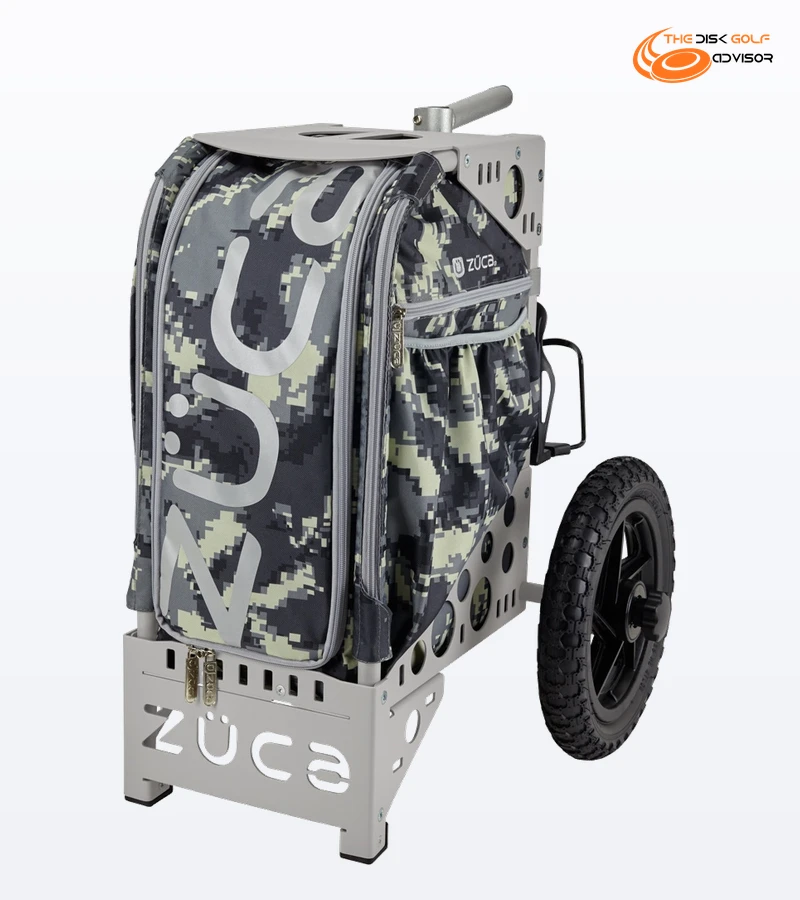
If you walk the fairways at any PDGA National Tour event, the ZÜCA All-Terrain Cart is the ubiquitous frame you see parked beside every tee pad. Originally developed as an indestructible aerospace rolling frame for traveling athletes, ZÜCA adapted this platform for disc golf by wrapping a heavy-duty water-resistant polyester insert bag inside an external aluminum exoskeleton.
The crowning feature of this cart is the built-in top platform. When you get backed up on a tournament card with three groups stacked on a par-five tee pad, you don’t hunt around for dry logs or sit on wet grass. You drop the handle, sit down directly on the 300-pound rated aluminum deck, and relax your legs. That integrated chair alone saves immense physical fatigue over a four-hour round.
Frame Architecture, Built-In 300 lb Seat & Foam Tires
The roll cage is precision-welded from lightweight aluminum alloy, finished in durable powder-coating that resists chipping when scraping past Midwestern briars. Its 12.5-inch wheels feature sealed cartridge bearings that keep mud and grit from seizing the axle, wrapped in dense, tubeless polyurethane foam. You can drag this cart straight over sharp honey locust thorns and broken glass without ever experiencing a flat tire.
Inside the chassis sits a stepped rack system that holds up to thirty-two discs, accompanied by zippered side gussets, dual external drink holders that fit 32-ounce Hydro Flasks, and internal mesh pockets for scorecards, towels, and grip wax.
Hillside Stability, Root Traversal & Fairway Performance
With an axle track width of twenty-two inches, the All-Terrain cart tracks smoothly over gnarly tree root clusters. On steep 20-degree hillside banks at Bradley Park, the low center of gravity keeps the frame glued to the turf unless you yank it aggressively across vertical ruts. When descending steep ravines, you can spin the frame around and guide it down ahead of you using the telescoping handle as a stabilizer.
- Indestructible 300-pound built-in seat eliminates tournament backup fatigue
- Tubeless foam-filled tires are 100% immune to thorns and sharp trail rocks
- Enormous modular ecosystem with custom putter pouches, fenders, and umbrella clamps
- Two-wheel pull geometry can strain shoulders when dragging up severe muddy hills
- Discs can rattle against the metal frame over rocky paths unless lined with foam
2. ZÜCA Backpack Cart LG: The Ultimate Platform for Existing Bags
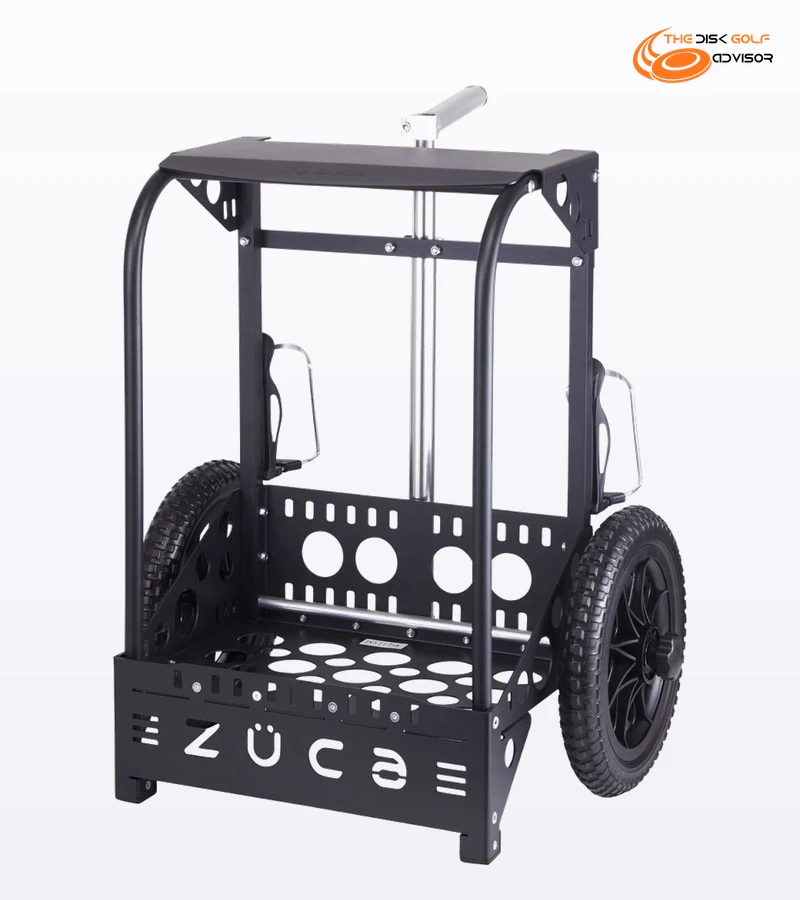
If you already spent three hundred dollars on a handcrafted tournament backpack like a GRIPeq AX6 or Pound Octothorpe, the last thing you want is a cart that forces you to abandon your bag and transfer discs one by one into an unfamiliar rack. That is the exact problem the ZÜCA Backpack Cart LG solves.
The standard ZÜCA backpack cart was engineered for mid-sized bags, meaning wide tour packs had to be jammed between the upright bars, pinching external bottle pockets and tearing zipper fabric. The “LG” (Large) model widens the interior bay to sixteen full inches, allowing your favorite tour bag to drop cleanly onto the floorboard with zero friction.
Expandable Axle Geometry & Bag Compartment Dimensions
The LG frame features an extended stance that broadens the wheel track to twenty-four inches. This wider wheelbase dramatically increases lateral stability, virtually eliminating the annoying side-tip tendencies that plagued early two-wheel carts on off-camber fairways. The open front design leaves your backpack’s primary disc flap wide open, so you retain the exact muscle-memory disc access you are accustomed to on the course.
Below the main bag shelf sits a built-in three-inch under-carriage storage space. This creates an ideal dry compartment for rain flies, extra socks, or retriever poles that you don’t want crowding your main bag pockets.
Ergonomics, Heavy Payload Transport & Fairway Utility
Because the weight of your bag sits low against the rear axle, the balance point is sublime. When tilted back into rolling position, the handle feels almost weightless in your palm. On steep ascents, the wide tires roll cleanly over fallen timber without getting caught in leaf mulch.
- Wide 16-inch interior fits large tour backpacks without compressing side pockets
- Maintains your existing bag organization while adding a 300 lb built-in seat
- Extended wheelbase provides superior side-hill tip resistance over standard frames
- Wider wheel track requires careful steering through narrow wooded footbridges
- Heavier total setup when carrying a fully loaded tour bag inside the aluminum frame
3. Rovic RV1D 2.0 Disc Golf Push Cart: The Ergonomic Back & Shoulder Savior
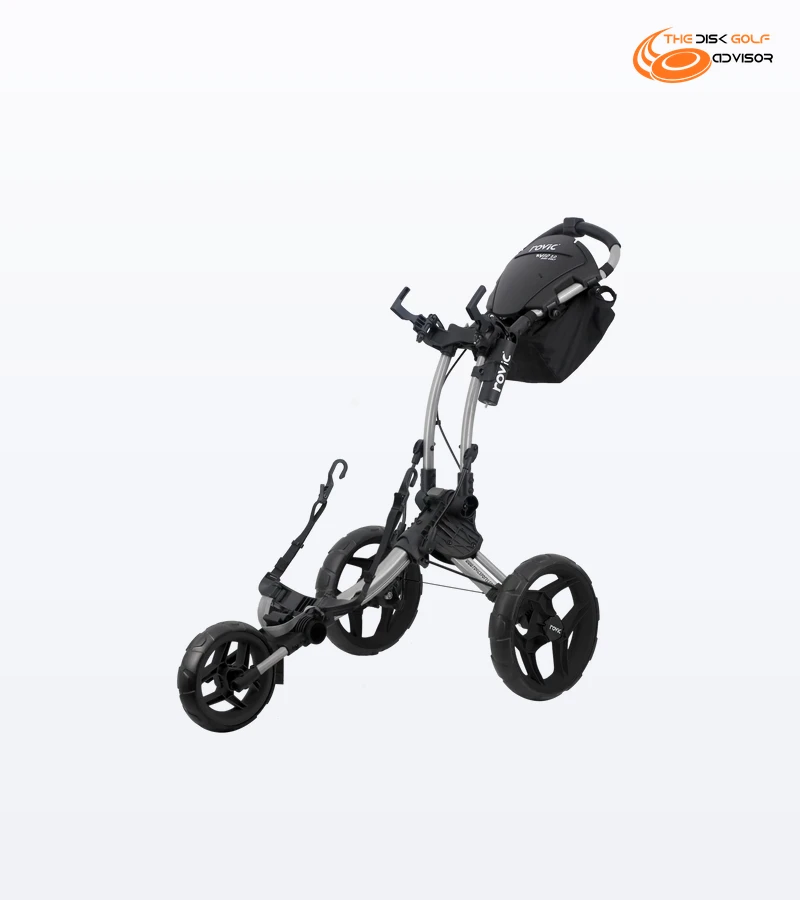
For decades, traditional ball golfers pushed three-wheel carts rather than pulling two-wheel trolleys behind them. The biomechanical reasoning is simple: pushing keeps your chest open, your shoulders square, and your spine completely neutral. The Rovic RV1D 2.0 brings that elite ergonomic engineering directly to disc golf fairways.
Manufactured by Clicgear (the gold standard in ball-golf push carts), the RV1D features an arched aluminum spine with an angled lower cradle specifically contoured to support heavy disc golf backpacks. Instead of dragging a frame behind you with one arm twisted backward, you push with both hands, letting your leg stride do the work.
3-Wheel Push Geometry & Hand Brake Engineering
The standout feature on the fairway is the console-mounted handbrake. When parking on a 30-degree hillside to line up a drive with your distance driver, you simply flick the red lever on the console. A positive-lock pin engages the wheel hub, freezing the cart in place with zero risk of runaway rollaways.
The three airless oversized wheels feature deep rubber tread that rolls effortlessly through thick rough and tall fescue grass where two-wheel pull carts bog down like anchors.
Fairway Rolling Resistance & Compact Folded Footprint
When the round is over, the RV1D collapses with a single latch mechanism into an astonishingly compact twenty-four-inch bundle. It takes up less trunk space than almost any vertical cart on the market, leaving ample room for luggage or coolers.
- Forward-push geometry completely eliminates shoulder and rotator cuff strain
- Console-mounted handbrake holds firmly on steep hillsides without rolling away
- Folds into an ultra-compact footprint that easily fits into small sports car trunks
- Does not come standard with a built-in seat (requires purchasing clip-on accessory stool)
- Front wheel can catch on deep perpendicular root trenches if not popped upward
4. ZÜCA Compact Cart: The Minimalist & Budget-Conscious Cruiser
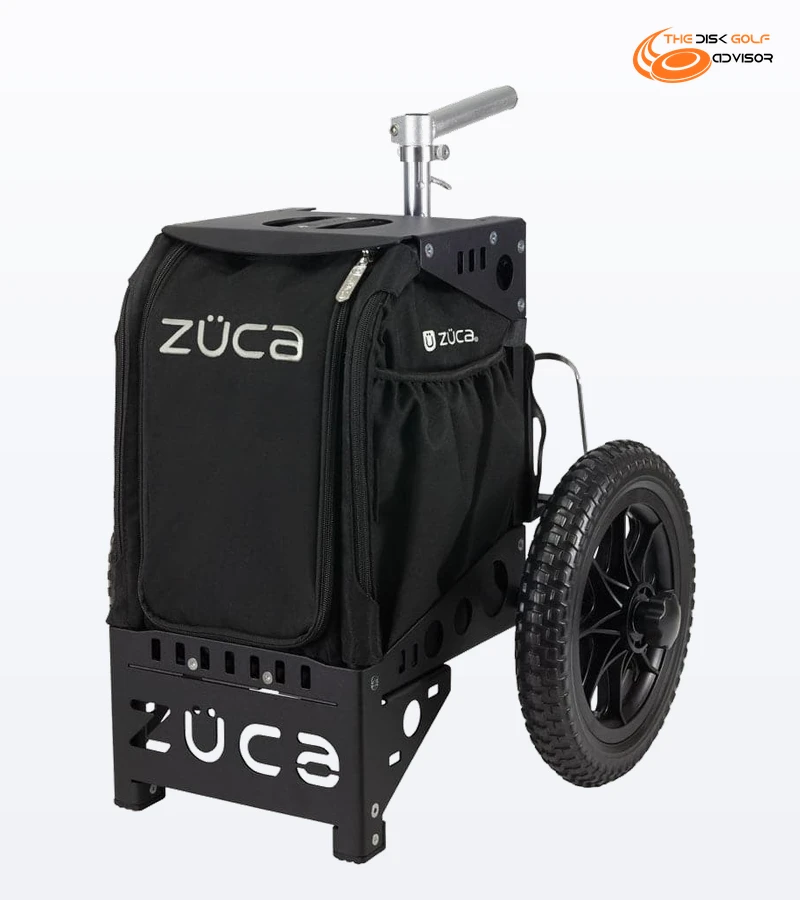
Not everyone needs to haul thirty-five discs, three jackets, and a portable sound system on the course. For players who throw a refined quiver of fifteen discs and play tight, technical wooded courses, full-sized carts feel like driving a semi-truck through a bicycle lane. The ZÜCA Compact Cart was engineered specifically for agile minimalism.
Weighing just eleven pounds empty, the Compact is nearly five pounds lighter than the Backpack LG. It retains the signature 300-pound aluminum seat, giving you all the tournament-backup comfort of the flagship models without the cumbersome bulk.
Narrow Wheelbase & Integrated Disc Bay Layout
The wheel track measures twenty inches wide: two to four inches narrower than full-sized carts. On tight wooded corridors like hole 12 at Northwoods Black, where narrow footpaths are pinched between tight trees, the Compact slips through effortlessly where wider carts bang against bark.
Discs sit on a stepped interior tray that holds fifteen to eighteen molds securely. Two quick-access slots in the top flap keep your primary putting putters right at your fingertips without unzipping the main chamber.
Tight Wooded Corridor Maneuverability & Course Utility
Because the frame is compact and light, lifting it over fallen creek logs or hopping it across rocky drainage ditches requires minimal effort. It is the premier choice for junior players, petite throwers, or anyone who drives a compact hatchback with tight cargo room.
- Ultralight 11-pound design is effortless to pull and lift across creek ditches
- Narrow 20-inch width navigates tight wooded fairways without clipping trees
- Full 300-pound built-in seat at a substantially lower price point than tour carts
- Limited disc storage (15–18 discs) leaves no room for surplus backup discs
- Narrower wheelbase makes it slightly more prone to tipping on severe side hills
5. Bag Boy Quad XL Disc Golf Cart: The 4-Wheel Anti-Tip Hillside Tank
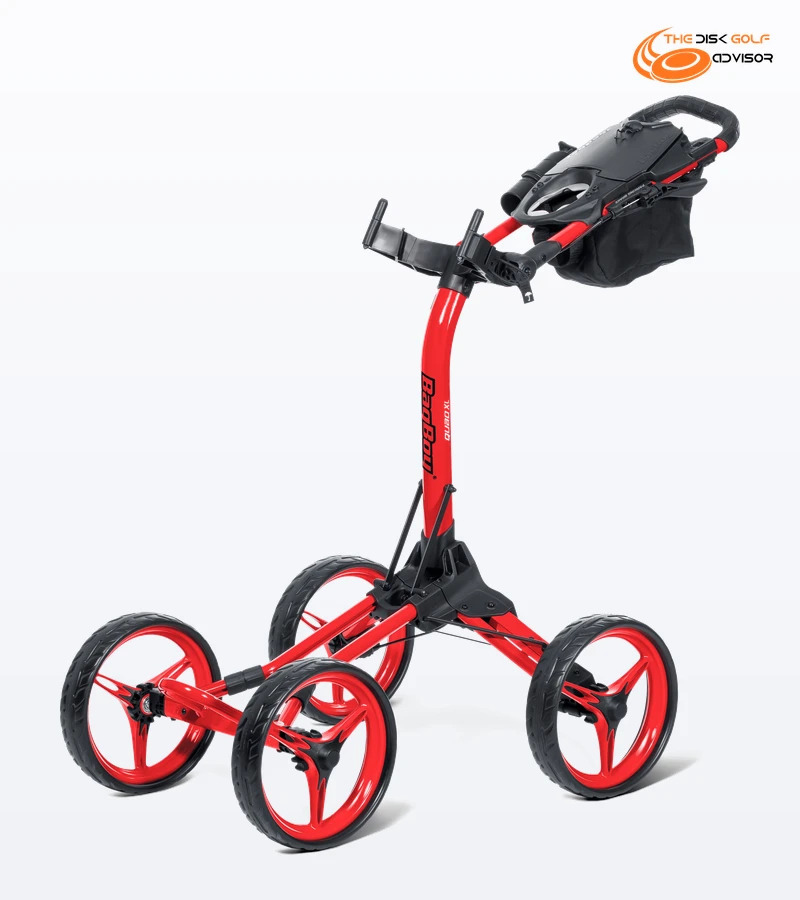
If your local home course features extreme topographical elevation—like the ravines of Peoria or the ski slopes of Colorado—two-wheel pull carts will test your patience. One misstep on a side-slope and a two-wheel frame tips over, dumping discs down the hill. The Bag Boy Quad XL eliminates tip-overs completely through four-wheel independent geometry.
Originating in the ball-golf sector where stability over rolling hills is non-negotiable, the Quad XL features an ultra-wide rectangular wheel stance. You can let go of the handle in the middle of a 25-degree hillside, and the cart sits dead-solid on all four tires without even wobbling.
4-Wheel Independent Suspension & Stand-Bag Cradle
The forward wheels track straight ahead while the rear wheels absorb lateral side loads. The upper and lower support arms feature adjustable rubber bungee clasps that securely lock large backpacks in place. Whether you carry a rigid GRIPeq or an unstructured starter bag, the load stays centered without shifting sideways during travel.
The handle console is the best in the business: featuring a deep scorecard holder, pencil clips, an umbrella mounting receptor, and an oversized mesh beverage caddy that holds large metal vacuum growlers.
Extreme Slope Stability & Mud Resistance
Pushing four wheels distributed across eighty square inches of contact area prevents the cart from sinking into soggy spring mud. While two-wheel carts dig trenches in saturated Midwestern turf, the Quad XL floats across the surface with minimal rolling resistance.
- Virtually un-tippable 4-wheel platform provides unmatched hillside security
- Superior handle console with built-in umbrella receptor, storage bin, and phone holder
- Simple two-step folding action collapses flat for garage and trunk storage
- Takes up more trunk floor area than narrow upright vertical carts
- Requires lifting front wheels slightly to make sharp 90-degree pivot turns
6. ZÜCA Transit Cart: The All-in-One Multi-Tier Rolling Locker
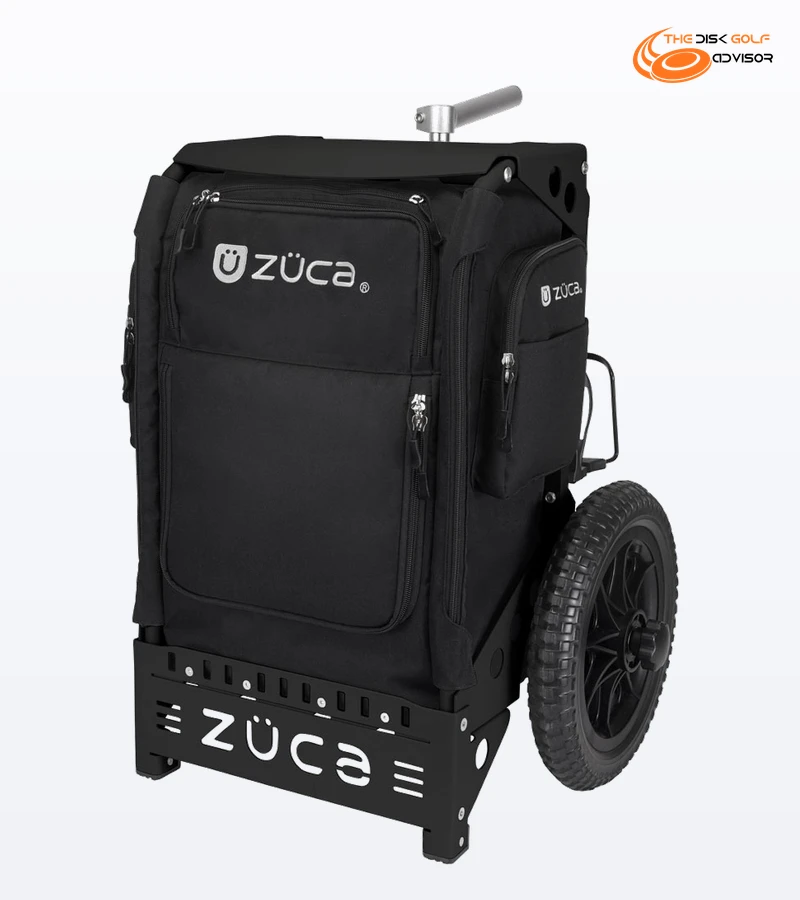
Standard vertical carts feature front-facing zippered doors, meaning you have to bend down or crouch to pull discs out of the lower rack. For taller players or anyone with knee arthritis, that repetitive bending defeats the purpose of buying a rolling cart. The ZÜCA Transit Cart flips the paradigm by engineering a top-loading disc bay directly under a hinged seat.
You lift the padded top lid, and your entire twenty-five-disc quiver sits upright at waist height. Selecting a driver or checking flight numbers takes zero bending effort, making it the most posture-friendly upright cart on the market.
Multi-Tier Internal Shelving & Top-Loading Lid
Beneath the primary top-loading disc bay sits a secondary lower storage locker. This cavernous bottom compartment holds extra layers, rain suits, lunch boxes, and up to four backup discs. The entire inner tub is lined with heavy-gauge coated nylon that wipes clean after wet rounds.
The frame rides on ZÜCA’s proven 12.5-inch tubeless polyurethane wheels, with quick-release axle pins that allow you to strip the wheels off in three seconds flat for tight vehicle storage.
Cold-Weather Tournament Utility & Gear Organization
During late-autumn Midwestern tournaments when temperatures hover around forty degrees, the Transit doubles as a mobile warming station. You can pack hand warmers, a vacuum thermos of hot coffee, dry towels, and mittens in the lower tub while keeping your primary throwing plastics warm and dry under the insulated seat lid.
- Top-loading disc bay provides waist-height access with zero crouching or bending
- Enormous lower compartment serves as an all-weather gear locker for apparel and food
- Full 300-pound aluminum integrated seat for tournament backup rest
- You must stand up from the seat whenever you need to retrieve a disc from the top bay
- Slightly higher vertical profile creates higher wind drag during blustery prairie rounds
7. MVP Rover Cart: The Low-Center-of-Gravity Lightweight Alternative
Not every player wants a towering aluminum roll cage. The engineers at MVP Disc Sports (famed for their gyro-overmold engineering on molds like the Glitch and Crave in our best disc golf brands guide) took a completely different approach with the MVP Rover Cart.
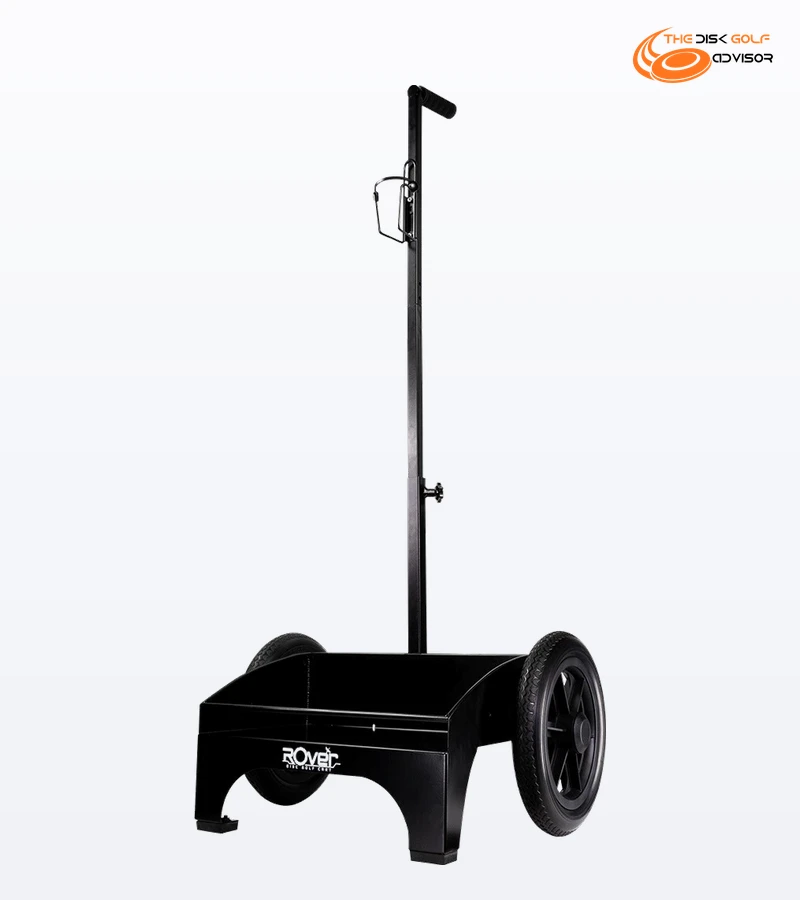
Instead of building an upright box with a heavy seat, MVP designed an open, low-slung steel sled that positions your backpack just three inches above the ground between two oversized wheels. By placing the center of mass below the axle line, the Rover achieves astonishing lateral stability without needing a wide footprint.
Low-Profile Ground Clearance & Universal Bag Straps
The Rover features an open tubular cradle with dual adjustable nylon web straps. You take whatever backpack you currently own—from an entry-level starter bag to a tour-grade pack—drop it onto the base, click the buckles, and pull. It fits virtually every bag on the market without width restrictions.
The telescoping handle locks firmly into place with dual tension clamps, offering adjustable height settings for throwers ranging from 5’4″ to 6’4″.
Flat-Ground Rolling Efficiency & Travel Storage
At eleven and a half pounds, pulling the Rover on flat ground feels frictionless. The oversized wheels glide over fairway turf, and because there is no metal box enclosing the discs, there is zero metallic rattling. When traveling, the handle unlatches and folds flush against the chassis, creating a flat profile that slides under luggage or truck toolboxes with ease.
- Low center of gravity positions bag weight below the axle for incredible tip stability
- Universal open cradle accepts virtually any backpack brand without size restrictions
- Frictionless silent roll with zero metal-on-metal disc rattling
- No built-in seat (requires carrying an external tripod stool)
- Low ground clearance can drag in deep water puddles or high unmaintained mud
Push Cart vs. Pull Cart: The Biomechanics of Fairway Fatigue
The biggest debate across Reddit’s r/discgolf and Facebook equipment forums centers on Pushing vs. Pulling. While traditional upright carts like the ZÜCA are pulled behind your dominant side, converted push carts like the Rovic and Bag Boy are pushed in front of you. Understanding the biomechanics helps you choose the right frame for your physical health.
Why Pushing Saves Rotator Cuffs and Lower Backs
When you pull a two-wheel cart behind you, your trailing arm is held in extension and internal rotation. Over five miles of walking, this uneven asymmetrical load twists your thoracic spine and places continuous tension on your anterior shoulder capsule. For players who throw high-velocity forehands or have past rotator cuff strains, this dragging motion causes subtle muscle tightening that robs power off the tee.
Pushing a three- or four-wheel cart allows both arms to rest comfortably on an ergonomic handle bar. Your chest stays open, your shoulders remain square, and your spine stays vertically aligned. You utilize your larger quadriceps and glutes to propel the cart forward, leaving your upper body relaxed for throwing.
When a Two-Wheel Pull Cart Wins: Roots, Rocks & Heavy Mud
Push carts dominate on parkland, ball-golf style courses, and maintained fairways. However, when you play rugged, rocky mountain courses or wooded Midwestern ravines with vertical ledge drops, two-wheel pull carts hold a distinct advantage. You can lean a two-wheel ZÜCA onto its rear tires, hop it over exposed twelve-inch logs, or spin it around and carry it backward down boulder steps where a three-wheel pushcart would get hung up on its front nose wheel.
Foam-Filled vs. Pneumatic Air Tires: Preventing Fairway Headaches
Tire selection makes the difference between a smooth weekend and a ruined round:
Thorn & Puncture Resistance
Never buy a disc golf cart with standard pneumatic bicycle inner tubes unless you are prepared to carry a hand pump and tire levers. Midwestern courses are packed with honey locust trees, gooseberry thorns, and sharp shale rock. A single locust thorn will puncture an air tube in seconds. Modern tubeless foam-filled tires (standard on ZÜCA and Rovic) are molded from dense micro-cellular polyurethane. They never lose pressure, never go flat, and are completely impervious to thorns and glass.
Rolling Vibration & Disc Rattle Management
Foam tires are stiffer than air tires, meaning they transmit higher ground vibration through the axle into the frame. On gravel pathways, this vibration causes discs to buzz and rattle against aluminum frame bars. You can easily eliminate this noise by installing two 50-cent nylon washers on the axle between the wheel hub and quick-release cotter pin to eliminate side-to-side wheel play, and lining the inner floorboard of the cart with 1/4-inch neoprene shelf liner.
Frequently Asked Questions
Are disc golf carts actually worth the money, or do they make hilly courses harder? (Reddit r/discgolf Query)
Across flat, rolling, or moderately wooded courses, carts are worth every penny. Eliminating 25 pounds of dead weight from your spine saves an estimated 20% to 30% of physical fatigue over a 36-hole tournament weekend. However, on courses featuring steep cliff scrambles, unmaintained boulder stairs, or thick swamp mud, dragging a 35-pound dead-weight cart causes more physical exhaustion than carrying an ergonomic backpack like a Pound or GRIPeq. Most touring players own both: a cart for 80% of rounds, and a backpack for extreme mountain terrain.
Will my GRIPeq, Pound, or Squatch backpack fit into a standard ZÜCA Backpack Cart? (Facebook Group Query)
Medium-sized bags (GRIPeq BX3, Dynamic Discs Commander, Upper Park Shift) fit easily into the standard ZÜCA Backpack Cart. However, large tour-grade packs (GRIPeq AX6, Pound Octothorpe, Squatch Legend 3.0) are too wide for the standard frame and will have their side drink holders pinched. For these massive tour bags, you must purchase the ZÜCA Backpack Cart LG (Large), which expands the internal bay width to 16 full inches.
Why are so many players switching from 2-wheel pull carts to 3-wheel push carts? (Reddit r/discgolf Query)
Ergonomics and joint preservation. Pulling a two-wheel cart behind you forces your shoulder into backward extension and twists your spine sideways for 4 to 5 miles, which can aggravate rotator cuff, neck, and lumbar issues. Pushing a 3-wheel cart (like the Rovic RV1D) keeps your spine neutral, opens your chest, and lets your legs do the work. The only drawback is that push carts do not include built-in seats like ZÜCA frames.
How do I eliminate the loud metallic rattling noise on my ZÜCA cart? (Quora Disc Golf Query)
The “ZÜCA rattle” comes from two sources: lateral axle play and discs shifting in the metal basket. First, add one or two 1/2-inch nylon or rubber washers between the wheel hub and cotter pin to eliminate wheel wobble. Second, line the bottom and rear aluminum frame bars with self-adhesive 1/4-inch neoprene shelf liner or closed-cell foam tape. This deadens disc vibrations and makes the cart whisper-quiet over gravel paths.
Can I take a disc golf cart on an airplane as checked luggage? (Quora Travel Query)
Yes. By popping off the quick-release wheels and sliding the telescoping handle down into the chassis, a ZÜCA or Rovic cart fits easily into standard 28-inch checked hard-shell suitcases or dedicated padded travel duffels. An empty cart weighs between 11 and 16 pounds, leaving over 30 pounds of weight allowance for discs and apparel under standard 50-pound airline limits.
What are the essential accessories worth buying for a disc golf cart? (Facebook Group Query)
Four accessories provide immediate value: 1. An elevated Putter Pouch mounted to the handle (eliminates bending down for putts inside Circle 1); 2. A memory-foam Seat Cushion (insulates against cold steel during 20-minute tournament delays); 3. Wheel Mud Fenders (prevents wet tire spray from soaking your towel and bag fabric); and 4. A heavy-duty Umbrella Holder with screw clamps for hands-free rain coverage.
How does a cart perform in snow and heavy winter slush? (Reddit r/discgolf Query)
In light, packed snow up to three inches, standard 12.5-inch foam wheels roll reasonably well. However, in deep powder or heavy slush, wheels act like snow plows, creating tremendous dragging resistance. Many Midwest and Scandinavian winter golfers install aftermarket ski sled attachments that clip onto the wheel axles, allowing the cart to glide across frozen snow with virtually zero friction.
Final Verdict: Choosing Your Fairway Rolling Setup
Carrying a heavy backpack around the course is not a badge of honor; it is an avoidable source of physical fatigue that ruins your posture and steals distance off the tee. When selecting your cart, match the frame architecture to your local course terrain and physical needs:
The Pro Recommended Setup by Player Type
Recommendation: ZÜCA All-Terrain Disc Golf Cart
Why: The gold standard for competitive tournament play. The certified 300-pound seat provides essential rest during card backups, while the all-terrain foam wheels tackle rocks, roots, and curbs with zero flat tire anxiety.
Recommendation: ZÜCA Backpack Cart LG
Why: Accommodates full-size tournament backpacks from GRIPeq, Pound, and Squatch without crushing side water pockets, giving you instant rolling relief while preserving your personal bag layout.
Recommendation: Rovic RV1D 2.0 Disc Golf Push Cart
Why: Forward-pushing ergonomics keep your chest open and spine vertically aligned, saving your rotator cuff and lumbar spine across long 36-hole tournament weekends.
Pair your rolling setup with our field-tested recommendations for the best disc golf bags, explore our master breakdown of the best disc golf brands, dial in your close-range confidence with the best disc golf putters and our top-rated practice disc golf baskets, optimize your distance lines with our tested distance drivers, or review our starter guide to beginner discs. We will see you on the fairways!