
At a Glance: The 4-Tier Quick Decision Box
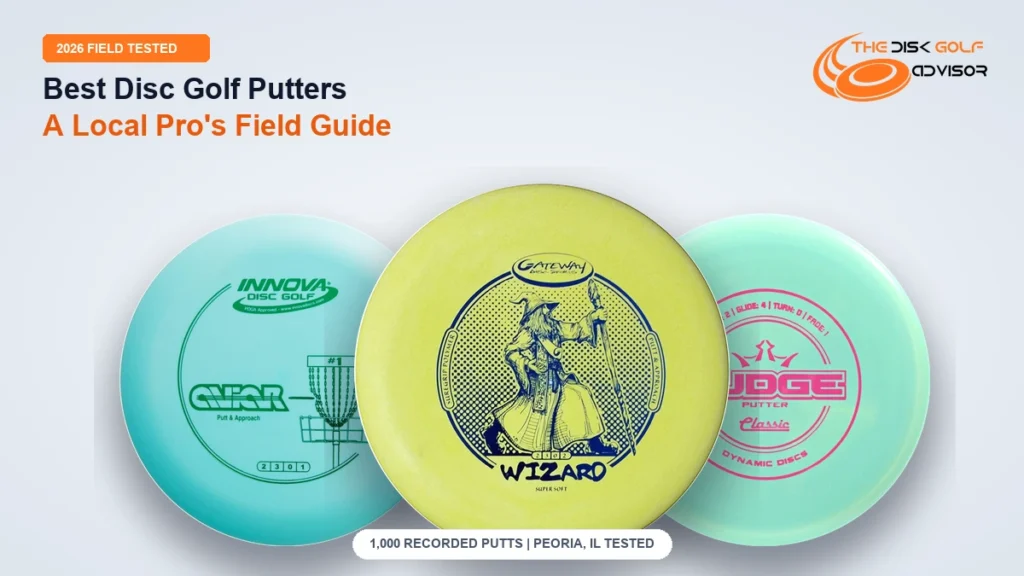
If you want to cut through marketing hype and stop missing 15-footers, here are my top field-tested putters based on 1,000 recorded practice putts across Central Illinois:
- 1. Best All-Around Beadless Putting Standard: Innova Aviar (Speed 2 / Glide 3 / Turn 0 / Fade 1): The winningest mold in championship history; clean, smooth release for every putting style in classic DX plastic.
- 2. Best Beaded Putting Putter & Cold-Weather Grip: Gateway Wizard (Speed 2 / Glide 3 / Turn 0 / Fade 2): Renowned big-bead rim with chalky Super Soft (SS / SSS) plastic that sticks to cold galvanized chains below 40°F.
- 3. Best High-Glide Push Putter: Dynamic Discs Judge (Speed 2 / Glide 4 / Turn 0 / Fade 1): Micro-bead rim paired with floaty 4-glide in Classic Blend; effortlessly carries into the basket from 30+ feet.
- 4. Best Driving & Throwing Putter Off the Tee: Axiom Envy (Speed 3 / Glide 3 / Turn 0 / Fade 2): James Conrad “Holy Shot” legend; GYRO overmold technology resists high-speed torque on 250-foot driving lines.
Table of Contents
- Why Most Putts Miss: The Putter Selection Trap
- How We Tested: 1,000 Putts Across Peoria Greens
- Master Technical Comparison Matrix
- The 7 Best Disc Golf Putters: In-Depth Field Reviews
- Putting Putters vs. Throwing Putters: The Essential Distinction
- Beaded vs. Beadless Putters: How Rim Anatomy Affects Your Release
- Plastic Durometers and Chain Friction: Firm, Medium, or Soft
- Matching Your Putter to Your Putting Style: Spin vs. Push vs. Spush
- Frequently Asked Questions
- Final Verdict: The 2-Putter Pro Progression Quiver
Why Most Putts Miss: The Putter Selection Trap
On a cold October morning at McNaughton Park back in 2017, I stood twelve feet from the basket on hole 7 with a tap-in birdie on the line. I popped my brand-new premium plastic putter straight toward the center link.
It hit dead center chains at twenty miles an hour. Instead of dropping into the tray, the slick, rock-hard plastic glanced off the cold steel, kicked off the basket rim, and rolled twenty-five feet down into a drainage ditch. I missed the comeback putt and took a triple bogey that ended my tournament weekend.
The Vicious Putter Carousel Cycle
Miss a 15-Foot Putt: A simple mechanical slip-up occurs on an uphill or crosswind putt.
Blame the Mold or Bead: Instead of diagnosing finger release angles, you blame the disc profile.
Buy Rotating Molds Monthly: Adding 3 new putters resets your grip muscle memory.
Inconsistent Release Under Pressure: Subtle rim depth variances cause flutter on tournament putts.
For the next eight months, I blamed my discs for every missed putt. The trunk of my car became a graveyard of rotating putters: Aviars, Wizards, Judges, Challengers, and prototypes. Every time I changed molds, I reset the microscopic muscle memory in my index knuckle.
Here is the truth: Your putter has no built-in GPS. Putting is ninety percent confidence, tactile comfort, and a repeatable, flat release.
Switching molds every three weeks destroys your stroke. However, putting with the wrong physical design creates genuine mechanical barriers:
- Putting with slick premium plastic: Non-porous driver plastic bounces off cold galvanized chains.
- Forcing deep rims into small hands: Deep-dish putters drag against your palm on release, causing flutter.
- Putting with a warped driving disc: Ripping a baseline putter into a tree bends the rim, permanently ruining its flat flight inside twenty feet.
To stop missing tap-ins, you need the right tool for your specific hand size, putting stroke, and local climate.
How We Tested: 1,000 Putts Across Peoria Greens
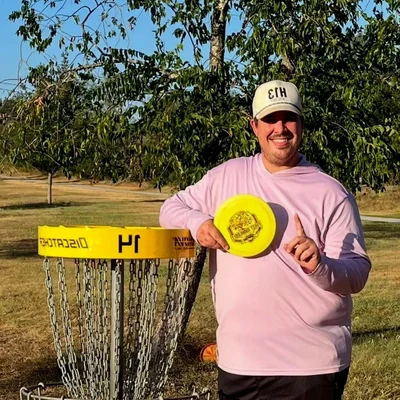
Every recommendation in this guide comes from hands-on testing on Central Illinois courses: the windy hillside at Bradley Park, the wooded fairways of McNaughton Park, Lake Eureka open greens, and my backyard Innova Discatcher basket in Peoria.
Marcus Vance Putter Testing Protocol
- 1. Volume: 1,000 recorded putts from standardized 15, 25, and 35-foot markers across multiple green slopes.
- 2. Environmental Testing: Evaluated in 88°F summer heat and 34°F freezing frost to test plastic chain grip.
- 3. Driving Benchmark: 200 to 250 ft flat-ground tee shots clocked with Bushnell radar guns.
- 4. Chain Adhesion Check: Recorded center-pole, weak-side, and high-chain impacts to track spit-out rates.
- 5. Sourcing Integrity: 100% retail-purchased stock plastic off pro shop shelves. No sponsored freebies.
Our testing followed three standardized phases:
- Circle 1 Consistency (15 and 25 Feet): Batches of 50 putts per mold to record chain retention, rim release friction, and spit-out rates on flat releases.
- Circle 2 Float (35 to 45 Feet): Evaluating aerodynamic glide and low-speed fade on step-putts in crosswinds.
- Off-the-Tee Driving Lines: Launching putts at 38 to 44 mph on open fairways at Lake Eureka to test torque resistance, wobble recovery, and landing ground action.
Master Technical Comparison Matrix
The table below compiles physical dimensions, flight ratings, bead styles, tested plastics, and measured 25-foot chain grab rates for our top 7 putters:
| Disc Mold | Manufacturer | Flight Numbers | Rim Depth | Bead Style | Tested Plastic | 25-Ft Chain Grab | Best Suited For |
|---|---|---|---|---|---|---|---|
| Innova Aviar | Innova Champion | 2 / 3 / 0 / 1 | 1.5 cm | Beadless | DX (175g) | 94% | Universal baseline standard for all putting strokes. |
| Gateway Wizard | Gateway Disc Sports | 2 / 3 / 0 / 2 | 1.5 cm | Big Bead | Super Soft SSS (175g) | 96% | Freezing weather grip and positive tactile indexing. |
| Dynamic Discs Judge | Dynamic Discs | 2 / 4 / 0 / 1 | 1.5 cm | Micro Bead | Classic Blend (175g) | 93% | Long push putts and effortless Circle 2 carry. |
| Axiom Envy | Axiom Discs | 3 / 3 / 0 / 2 | 1.4 cm | Beadless | Electron / Neutron (174g) | 91% | Power driving off the tee and windy approach lines. |
| Discraft Luna | Discraft | 3 / 3 / 0 / 3 | 1.4 cm | Beadless | Jawbreaker (174g) | 95% | Snappy, aggressive spin putters and gusty crosswinds. |
| Latitude 64 Pure | Latitude 64 | 3 / 3 / -1 / 1 | 1.4 cm | Beadless | Zero Medium (174g) | 92% | Smooth touch putting and laser tunnel drives. |
| Discmania P2 | Discmania | 2 / 3 / 0 / 2 | 1.5 cm | Beadless | D-Line Flex 2 (175g) | 94% | Deep-dish hand feel and dependable headwind stability. |
The 7 Best Disc Golf Putters: In-Depth Field Reviews
1. Innova Aviar (DX Plastic): The All-Time Championship Benchmark
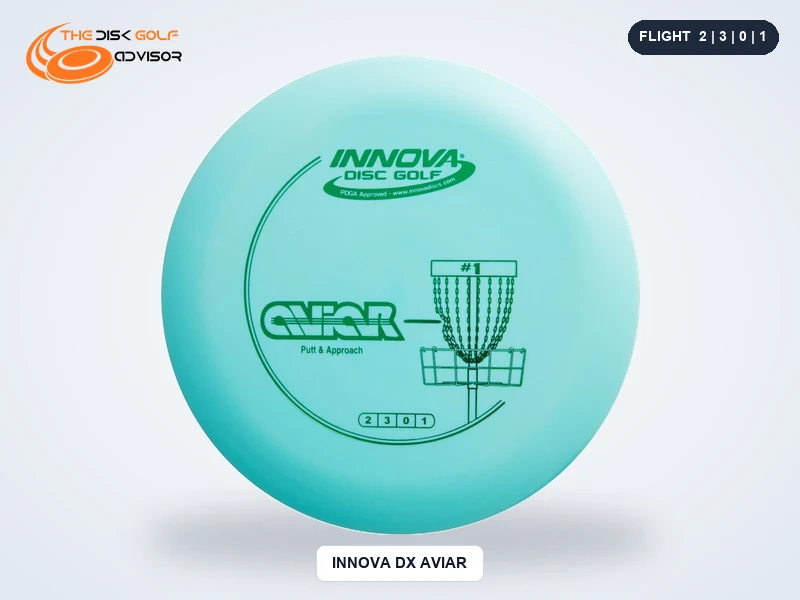
Back in 2012, before my first junior tournament at Bradley Park, my dad handed me a plain white 175-gram DX Aviar and said, “Learn to put this disc where you want it, and you will beat half the field.” First molded in 1984, the Aviar has won more PDGA World Championships than any disc in history, carrying Ken Climo to twelve titles and Paul McBeth to four.
Hand Feel and Putting Performance
The Aviar features a completely beadless bottom rim with a moderate 1.5-centimeter depth. The curved outer wing flows smoothly into the flat top flight plate without sharp ridges or steps. In Innova baseline DX plastic, the disc offers a chalky velvet texture that absorbs sweaty palm moisture during hot July rounds.
Inside twenty-five feet, the Aviar is pure point-and-shoot honesty. It flies dead flat with zero high-speed turn and a soft, forward-falling fade. In our 25-foot test sets, the DX Aviar recorded a 94% chain retention rate, absorbing impact against the center pole and dropping softly into the tray.
Driving & Approach Utility Off the Tee
Thrown flat at 38 mph on hole 2 at Bradley Park (a 210-foot wooded tunnel), the Aviar holds a frozen rope for 180 feet before settling with zero skip. However, baseline DX plastic will dent if you strike an oak tree at full power, so opt for Star or Champion plastic for tee duties.
- Timeless ergonomics fit nearly all hand sizes
- Inexpensive and universally available at every pro shop
- Completely honest, neutral flight line inside Circle 1
- Baseline DX plastic gouges on hard tree impacts
- Lacks the float of 4-glide putters for circle-two step-putts
2. Gateway Wizard (Super Soft / SSS): The Beaded Cold-Weather Grip Legend
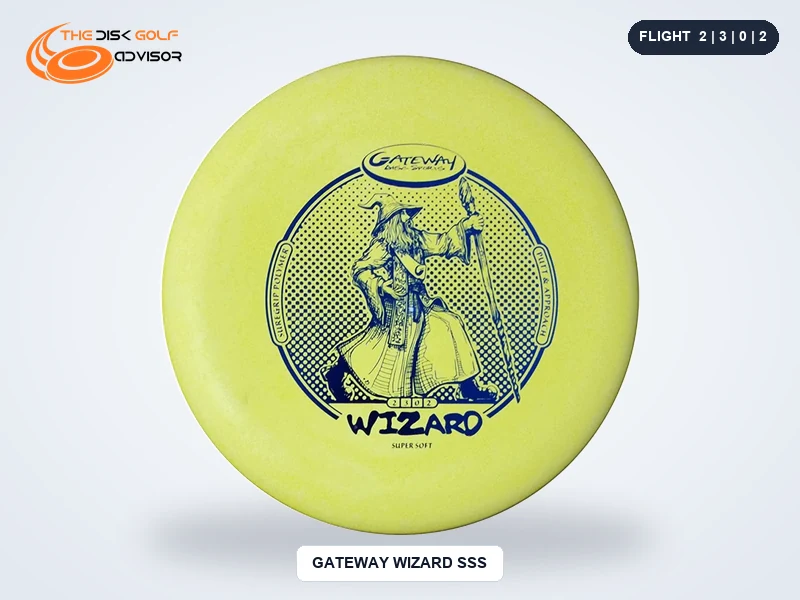
During a 34°F frost league round at McNaughton Park, my cardmates slick premium putters were ricocheting off frozen galvanized chains like hockey pucks. My chalky Gateway Super Stupid Soft (SSS) Wizard grabbed the frosted zinc links and dropped dead into the tray on every hole, earning me a four-stroke victory.
Hand Feel and Putting Performance
The Wizard features a prominent big bead along the bottom rim that serves as an unmistakable tactile indexing notch. The crease of your index finger locks directly under the bead, ensuring identical hand placement on every single putt. The flight plate is flat to slightly puddle-topped.
In our cold-weather trials, the SSS Wizard posted our highest score: a 96% chain retention rate. The rubberized compound deadens kinetic energy instantly on impact. With its 2 fade, the Wizard resists crosswinds and stays dependable when the breeze kicks up.
Driving & Approach Utility Off the Tee
Off the tee, that big bead acts as a structural bumper, stabilizing the disc against high-speed torque. Thrown at 40 mph, it flies dead straight for 200 feet before delivering a biting, predictable finish, sticking to hard turf without skipping away.
- Highest chain grab rate in freezing and wet conditions
- Big bead provides an unmistakable tactile finger reference
- Dependable low-speed overstability in windy conditions
- Large bead can feel bulky for players with small hands
- Minor plastic stiffness variance between factory runs
3. Dynamic Discs Judge (Classic Blend): The High-Glide Micro-Bead Workhorse
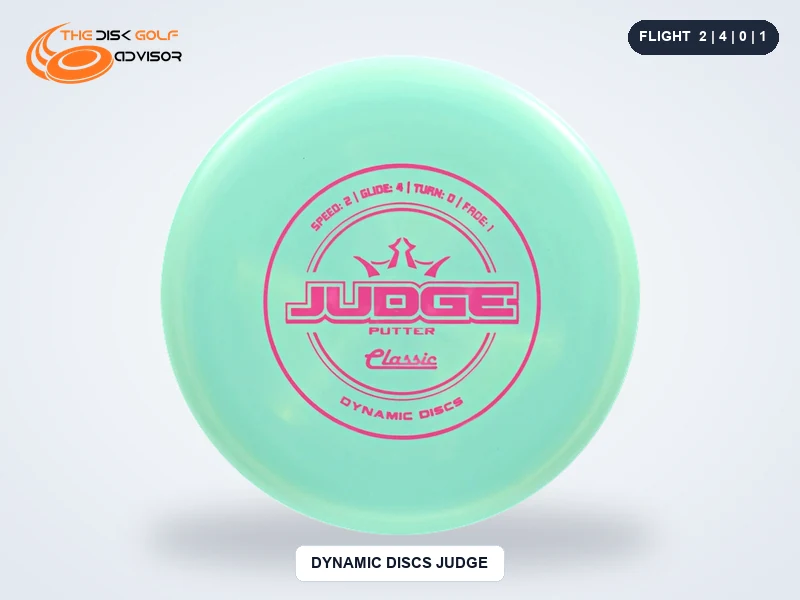
On hole 14 at Lake Eureka, facing a 38-foot Circle 2 putt with open water directly behind the pin, an aggressive spin putt carried the risk of sailing into the pond. I pulled out my Classic Blend Judge, gave it a smooth pendulum push, and watched its floaty 4-glide carry the disc effortlessly into the chains.
Hand Feel and Putting Performance
The Judge bridges the gap between big-bead discs like the Wizard and beadless rims like the Aviar by using a subtle micro-bead. It gives your index finger a positive tactile index without catching on release. Classic Blend plastic offers the ideal balance: stiff enough to resist thumb deflection, yet rubbery enough for immediate wet-weather traction.
With a 4 glide rating, the Judge stays airborne longer than traditional putters. For push putters who generate lower spin, this extra lift prevents putts from clanking against the front basket cage. In our 25-foot trials, it delivered a 93% chain retention rate.
Driving & Approach Utility Off the Tee
Off the tee, the Judge is one of the straightest-flying approach discs available, cruising 220 feet on a neutral line. However, that generous glide means missed putts can float 20 feet past the cage, requiring a focused comeback putt.
- Exceptional aerodynamic float on long 30+ foot putts
- Comfortable micro-bead fits a wide variety of hand sizes
- Flies laser-straight on full-power approach shots
- Missed putts can float 15 to 20 feet past the basket cage
- Classic baseline plastic beats in rapidly against rough trees
4. Axiom Envy (Electron / Neutron): The Undisputed King of Driving Putters
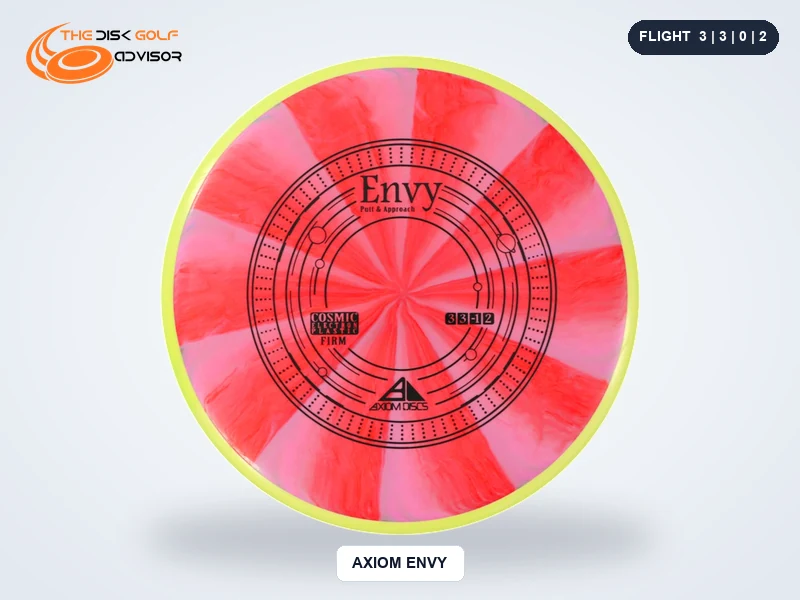
James Conrad cemented the Envy into disc golf folklore on hole 16 at the 2021 World Championships, throwing a 247-foot laser shot into the chains to force a playoff. On hole 11 at McNaughton Park: a 235-foot tunnel under a low oak canopy: the Envy is my go-to weapon. It flies on a frozen rope, avoids the heavy ground skip of a midrange, and parks within tap-in range.
Hand Feel and Driving Performance
The Envy features a shallow 1.4-centimeter rim depth and a flat flight plate. It utilizes Axiom GYRO Overmold technology: a dense, rubberized outer rim bonded to a stiff flight plate. That perimeter weighting maximizes rotational inertia, dampening high-speed torque and wrist flutter.
Clocked at 42 mph on Lake Eureka fairways, the Envy handled full power without turning over, averaging 242 feet of pinpoint carry before finishing with a mild forward fade. Its shallow rim also makes it the finest forehand touch putter on the market.
Inside Circle 1 Utility
While you can putt with an Envy in baseline Electron plastic, its premium Neutron blend is too slick for cold metal chains (recording a 91% chain grab rate). Reserve this mold for driving and approach duties.
- Handles maximum arm speed off the tee without flipping
- Shallow, flat profile excels for forehand approach touch
- Exceptional Neutron plastic durability against rock strikes
- Too fast and low-glide for floaty push putting strokes
- Premium plastic bounces off cold metal chains inside Circle 1
5. Discraft Luna (Jawbreaker Plastic): The Premier Spin Putter and Wind Controller
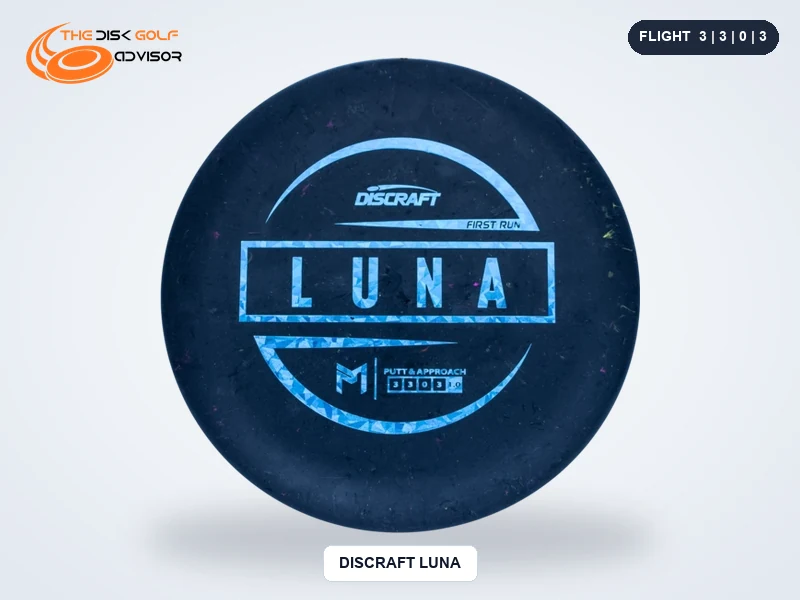
Co-designed by Paul McBeth, the Discraft Luna was engineered for aggressive spin putters who want a disc that pops off the fingers fast, pierces crosswinds, and hits the chains with authority. In 18-mph swirling winds on Bradley Park practice green, the Luna cut cleanly through gusts on a flat trajectory, posting a 95% chain retention rate.
Hand Feel and Putting Performance
The Luna has a shallow, beadless 1.4-centimeter rim with a sleek, rounded shoulder. In Discraft Jawbreaker rubber-composite blend, the disc has a tacky, semi-firm durometer with visible color speckles. Those rubber particles absorb kinetic energy against steel links, stopping rollaways.
Flight Dynamics Off the Tee & Driving Utility
Inside 30 feet, the Luna flies significantly straighter than its factory 3 fade suggests, holding a direct line into the center pole. Thrown with power off the tee, Jawbreaker plastic shows mild high-speed turn, making it a great hyzer-flip driving disc.
- Exceptional performance for high-velocity spin putters
- Rubberized Jawbreaker blend deadens chain hits and stops rollaways
- Reliable flight stability in breezy, gusty conditions
- More expensive than standard baseline putters
- Jawbreaker plastic beats in faster than premium blends
6. Latitude 64 Pure (Zero Medium): The Laser-Straight Touch & Tunnel Machine
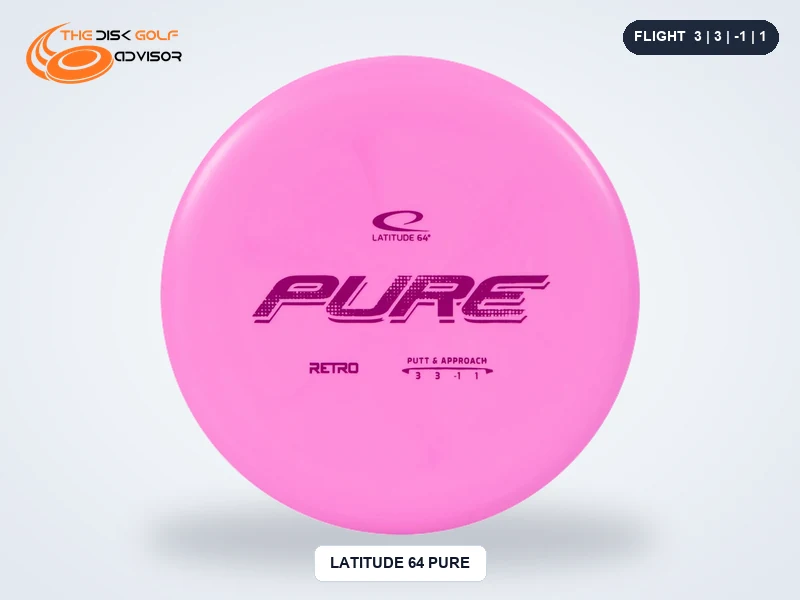
Swedish-engineered, the Latitude 64 Pure is famous as the straightest-flying beadless putter on the market. On hole 8 at McNaughton Park: a 160-foot wooded corridor guarded by hawthorn bushes: a putter with hard fade will kick into the thorns. The Pure floats on a dead-straight line from release to touchdown, settling softly under the pin.
Hand Feel and Putting Performance
The Pure is ultra-shallow (1.4 cm rim depth) with a flat top and zero bead. If you have shorter fingers or use a fan grip, it provides an exceptionally clean, catch-free release. Molded in Zero Medium plastic, it offers a chalky surface with comfortable thumb cushioning.
Approach Precision and Clean Release Touch
Inside the circle, the Pure holds whatever angle you give it with zero low-speed fade, recording a 92% chain retention rate. On 150-foot touch approaches through dense woods, it glides through tight tree gaps without veering off line.
- The straightest-flying beadless putter in disc golf
- Ultra-shallow rim provides a clean release for smaller hands
- Unmatched wooded touch approach accuracy
- Low fade makes it vulnerable to gusty headwinds
- Requires disciplined release angle control
7. Discmania P2 (D-Line Flex 2): The Deep-Dish Overstable Wind Fighter
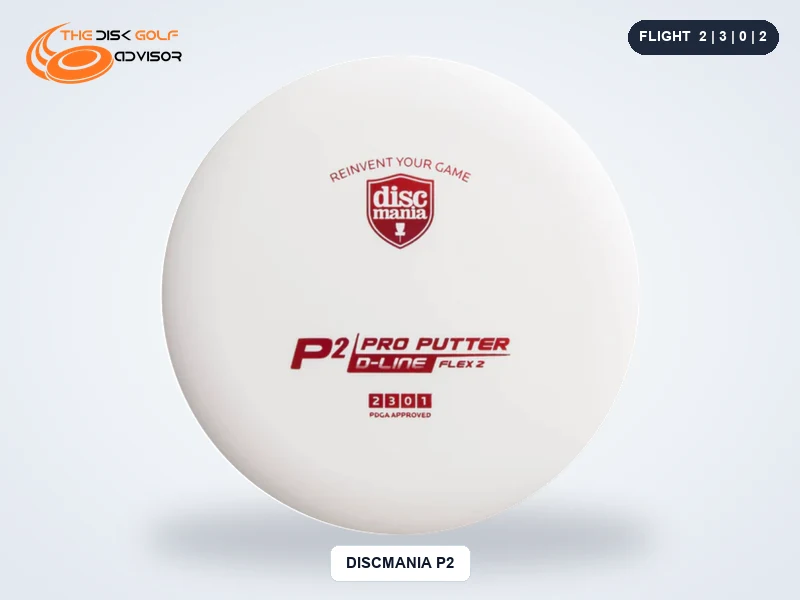
A staple in the bags of World Champions Simon Lizotte and Eagle McMahon, the Discmania P2 is the benchmark for players who prefer a deep, substantial beadless putter with dependable overstability. On hole 18 at Bradley Park, facing a 22-mph headwind with the gallery watching, my D-Line Flex 2 P2 punched straight through the gale into the center pole for the win.
Hand Feel and Putting Performance
The P2 features a deep 1.5-centimeter rim with a blunt, rounded nose that gives larger hands tremendous hand purchase. Molded in D-Line Flex 2 plastic, it provides the perfect balance of chalky grip and structural rigidity.
Headwind Resistance & Driving Power Off the Tee
Inside Circle 1, the P2 ignores crosswinds, recording a 94% chain retention rate. Its 2 fade gives you the confidence to put firm power behind your stroke without worrying about turning over or sailing deep past the basket. Thrown on a driving line off the tee pad, the P2 handles high torque without flipping, finishing with a dependable forward-penetrating hyzer.
- Exceptional headwind fighting stability inside Circle 1
- Deep rim provides massive grip purchase for large hands
- Available in three fine-tuned flex options (Soft, Medium, Hard)
- Deep rim can catch on release for players with smaller hands
- Requires firm spin outside 30 feet to prevent premature low-speed fade
Putting Putters vs. Throwing Putters: The Essential Distinction
One of the costliest mistakes beginners make is ripping their primary putting putter 220 feet off the tee into an oak tree, then wondering why it dives right on an eighteen-foot putt five holes later.
| Feature | Putting Putters | Throwing Putters |
|---|---|---|
| Intended Distance | Inside 60 feet | 150 to 260 feet |
| Plastic Category | Baseline (Soft, Velvety, Tacky) | Premium (Dense, Durable) |
| Chain Absorption | High (absorbs metal kinetic energy) | Low (slick, bounces off cold steel) |
| Tree Impact Durability | Low (dents and warps easily) | High (withstands hard rock impacts) |
| Torque Resistance | Moderate | High (resists high-speed wobble off tee) |
| Typical Example | DX Aviar, Classic Judge, SSS Wizard | Neutron Envy, Star Aviar, ESP Luna |
1. Putting Putters Belong Inside Circle 1:
Molded in baseline plastic (Innova DX, Gateway SSS, Dynamic Discs Classic, Discraft Jawbreaker). The porous, soft material deforms slightly on impact, absorbing kinetic energy and dropping the disc into the basket tray. However, a single 40-mph tree strike off the tee will bend the rim into a permanent warp, ruining its flat flight inside twenty feet.
2. Throwing Putters Belong on the Tee Pad:
Molded in dense premium plastic (Innova Star/Champion, Axiom Neutron, Discraft ESP). Designed to handle 40 to 50 mph launch velocities and resist wrist torque without flipping over. When thrown into trees, they ricochet off without structural damage. However, that same slick, hard plastic will bounce off cold metal chains inside Circle 1.
Beaded vs. Beadless Putters: How Rim Anatomy Affects Your Release
Turn a putter upside down and check the bottom outer rim. You will feel one of two physical designs: a smooth corner, or a raised circular lip called a bead.
| Anatomy Feature | Beaded Putters (Wizard, Judge) | Beadless Putters (Aviar, Pure, Luna, P2) |
|---|---|---|
| Bottom Rim Profile | Raised circular lip on bottom outer rim | Smooth, seamless rounded edge |
| Index Finger Feel | Resting shelf / tactile indexing notch | Catch-free, clean friction release |
| Wear-In Rate | Slower (bead absorbs initial turf wear) | Faster (wing bevel takes direct impact) |
| Low-Speed Fade | Slightly more overstable (Fade 2) | Neutral to straight forward push (Fade 1) |
| Recommended Stroke | Push Putting, Pitch Putting | Spin Putting, Touch Approaches |
1. Beaded Putters (Gateway Wizard, Dynamic Discs Judge):
The bead acts as a physical indexing shelf. When you set your grip, your index finger rests naturally into the groove beneath the bead, ensuring identical tactile placement every time. Beaded putters also stay overstable longer because the bead absorbs ground wear. Best for push putters.
2. Beadless Putters (Innova Aviar, Latitude 64 Pure, Discraft Luna):
Beadless putters have a smooth, rounded edge that provides a friction-free release with zero lip to catch against calluses or fingernails. Best for spin putters who rely on sharp wrist snap, as well as players with smaller hands.
Plastic Durometers and Chain Friction: Firm, Medium, or Soft
When a putter hits metal chains, physics determines whether it drops or spits out:
Kinetic Energy Absorbed = Chain Mass × Deflection + Plastic Deformation
Hard, slick plastic cannot deform on impact; kinetic energy bounces the disc away from the pole. Softer, tacky plastic deforms on contact, deadening the blow so gravity drops the disc into the tray.
| Durometer Class | Hardness Feel | Chain Grab Rate | Best Temperature & Weather |
|---|---|---|---|
| Firm (Stiff) | Rigid, zero flight plate flex | 90% to 92% | Hot Summer (80°F to 95°F) |
| Medium (Classic) | Velvety, slight thumb give | 93% to 95% | Spring / Fall (50°F to 75°F) |
| Soft / Super Soft | Gummy, flexible, rubberized | 95% to 97% | Freezing Frost (25°F to 45°F) |
- Firm (KC Pro, Gateway Firm, Classic Hard): Retains structural rigidity in hot summer weather (85°F+) when soft plastics get flimsy, but turns slick in freezing frost.
- Medium (Innova DX, Classic Blend, Zero Medium): The ideal sweet spot for 80% of players, offering chalky texture with mild cushion.
- Soft / Super Soft (Gateway SSS, Classic Soft, Electron Soft): Feels like pencil rubber. Sticks to freezing chains below 45°F, but can warp in hot car trunks.
Matching Your Putter to Your Putting Style: Spin vs. Push vs. Spush
Match your physical disc to your natural arm mechanics:
| Putting Style | Primary Hinge Point | Flight Trajectory | Ideal Putter Characteristics |
|---|---|---|---|
| Spin Putting | Wrist & Elbow snap | Flat, fast, direct into pole | Shallow, Beadless (Innova Aviar, Lat 64 Pure) |
| Push Putting | Shoulder pendulum | High lofted arc, soft drop | High Glide, Beaded (Dynamic Discs Judge) |
| Spush Putting | Shoulder lift + wrist snap | Moderate arc with crisp spin | Neutral depth, Mild Fade (Discraft Luna, Discmania P2) |
- Spin Putting: Driven by wrist and elbow snap. The disc flies fast, flat, and direct. Needs shallow, beadless putters (Aviar, Pure, Luna) that release cleanly without bead drag.
- Push Putting: Uses the arm as a shoulder pendulum with minimal wrist hinge. The disc lofts on an arc with low spin. Needs high-glide, beaded putters (Judge, Wizard) that stay airborne longer.
- Spush Putting: The modern hybrid standard combining shoulder lift with a crisp wrist pop at release. Thrives with versatile neutral putters (Luna, P2).
Frequently Asked Questions
Click on any question below to expand the full answer:
01
What putters are pros using in disc golf?
What putters are pros using in disc golf?
Top professional disc golfers primarily putt with baseline plastic putters like the Innova Aviar, Gateway Wizard, Dynamic Discs Judge, Discraft Luna, and Discmania P2. They choose baseline plastics (DX, Classic, Jawbreaker) because they absorb chain impacts and prevent rollaways.
02
What is the difference between a putting putter and a throwing putter?
What is the difference between a putting putter and a throwing putter?
A putting putter is used inside 60 feet, molded in soft, tacky baseline plastic to grab metal chains. A throwing putter is designed for full-power tee shots and approaches, molded in stiff, durable premium plastic (Star, Neutron, ESP) to withstand tree impacts without warping.
03
Should a disc golf putter be beaded or beadless?
Should a disc golf putter be beaded or beadless?
Beaded putters feature a small lip along the bottom rim that acts as a consistent index finger rest, offering a slightly more stable flight. Beadless putters have a smooth, rounded edge that provides a cleaner, catch-free release for spin putters and smaller hands.
04
What is the best disc golf putter for beginners?
What is the best disc golf putter for beginners?
The Innova DX Aviar and Latitude 64 Zero Medium Pure are the best putters for beginners. Their beadless, neutral flight paths (zero high-speed turn and minimal fade) fly dead straight inside Circle 1 and clearly reveal release angle errors.
05
How many putters should you carry in your bag?
How many putters should you carry in your bag?
Most competitive players carry three to four putters: two identical baseline putters reserved exclusively for putting inside Circle 1, one neutral throwing putter for straight tunnel approaches, and one overstable driving putter for windy tee shots and hyzers. If you need a backpack with dedicated top putter pockets to hold this rotation effortlessly, check our field-tested guide to the best disc golf bags.
06
Why do pros putt with baseline plastic instead of premium plastic? (Reddit r/discgolf Query)
Why do pros putt with baseline plastic instead of premium plastic? (Reddit r/discgolf Query)
Across Reddit’s r/discgolf community and the Disc Golf Pro Tour, over 90% of touring pros putt exclusively with baseline plastic (Innova DX, Gateway SSS, Discraft Jawbreaker, Latitude 64 Zero). Baseline plastic has a matte, chalky texture that absorbs sweat and moisture from your palms, providing superior tactile grip. More importantly, baseline plastics have higher kinetic absorption, which grabs galvanized steel chains and drops into the basket instead of deflecting off like slick premium plastics.
07
How do I build a repeatable putting routine at home? (Facebook Group Query)
How do I build a repeatable putting routine at home? (Facebook Group Query)
Buy two or three identical putters in the exact same mold, weight, and plastic. In your backyard or garage, set up at 15 feet. Do not practice from 30 or 40 feet until you make 90 out of 100 putts from 15 feet. Focus on the same pre-putt breath, hand placement, and finger spring. Practicing with identical discs eliminates hand confusion and cements muscle memory faster than cycling through random molds.
Final Verdict: The 2-Putter Pro Progression Quiver
Carrying half a dozen different putter molds only creates confusion and destroys putting consistency. Build a simple, repeatable Two-Putter Quiver:
The 2-Putter Pro Progression Quiver
Recommendation: Innova DX Aviar (Beadless) or Gateway Wizard SSS (Beaded)
Role: Exclusively for putting into chains inside 60 feet. Never thrown off the tee. Buy two identical putters in the same weight for warm-up muscle memory.
Recommendation: Axiom Envy (Neutron / Electron) or Innova Star Aviar
Role: 150 to 250 ft driving lines off the tee, full-power approaches, headwind shots.
Pick a mold that feels natural in your fingers, buy two identical discs in baseline plastic, practice twenty minutes a week on one of the best disc golf baskets for home practice, and commit to your release. Explore our comprehensive breakdown of the best disc golf brands, our complete guide to starter discs, our tested recommendations for distance drivers, and our roundup of the best disc golf bags to carry your quiver on the course, and we will see you on the fairways!