

Pick up almost any modern golf disc and you will spot a sequence of four numbers stamped cleanly across the flight plate: Speed, Glide, Turn, and Fade. To someone stepping onto the tee pad for the first time, these numbers look like a secret code. To retail manufacturers, they represent an aerodynamic blueprint. To everyday players looking to shave strokes off their scorecards, having disc golf flight numbers explained with real physics is the single most valuable asset you can develop before spending a dollar on new plastic.
Every weekend across Midwest courses like McNaughton Park in Pekin and Eureka Lake near Peoria, I watch enthusiastic beginners commit the exact same costly mistake. They walk into a local pro shop, head straight for the distance driver rack, spot an Innova Destroyer stamped with a bold Speed 12, and assume that a higher number guarantees a 350-foot throw. Twenty minutes later on Hole 1, they throw that 12-speed driver as hard as they can, only to watch it stall out at 180 feet and crash hard into the left rough.
The problem is not their athletic ability. The problem is a fundamental misunderstanding of what flight ratings measure. Flight numbers do not describe what a disc will automatically do for your game; they describe how a disc behaves when thrown at its specific designed release velocity with clean rotational spin.
The Local Pro Summary: The 4 Flight Numbers at a Glance
- Speed (1 to 14): The aerodynamic drag and rim width of the disc. Higher speed requires greater arm velocity to achieve its intended flight path.
- Glide (1 to 7): The disc’s capacity to maintain aerodynamic lift during forward flight. High glide floats; low glide resists wind and drops on command.
- Turn (+1 to -5): High-speed stability. The disc’s tendency to bank rightward (for a Right-Hand Backhand throw) during the first half of its flight.
- Fade (0 to 5): Low-Speed stability. The disc’s natural tendency to hook leftward (for a Right-Hand Backhand throw) as forward momentum decays.
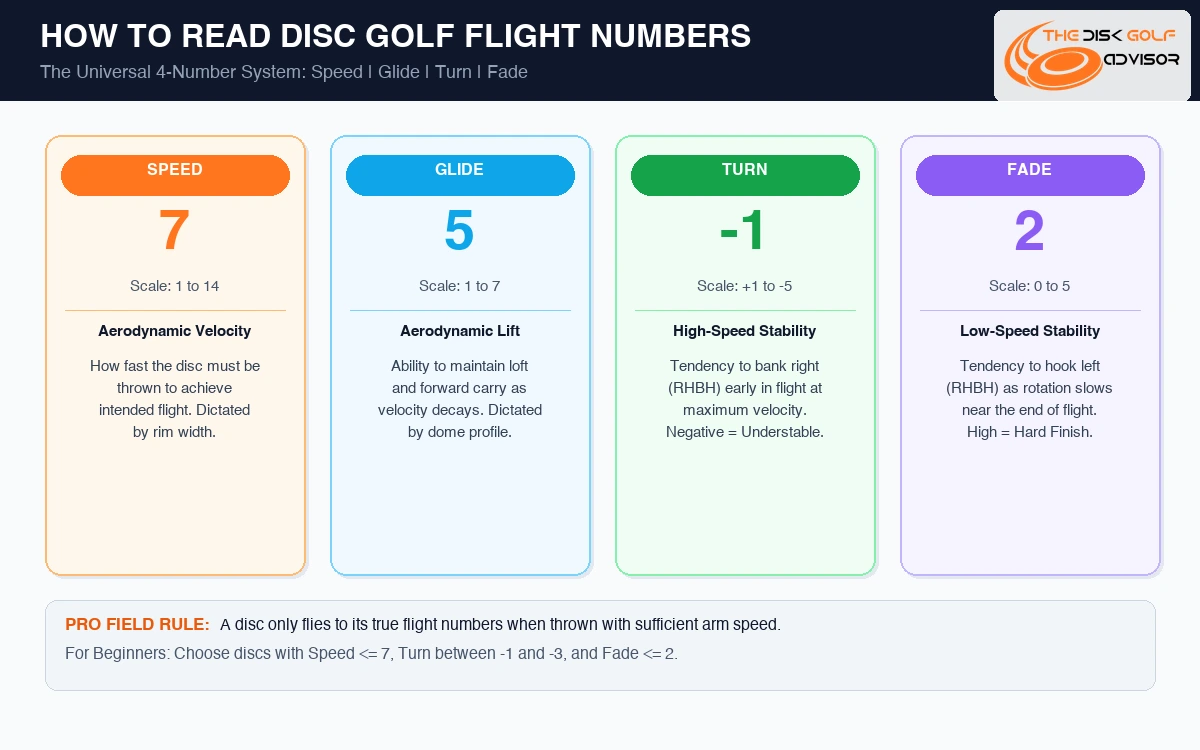
Figure 1: The universal four-number disc golf flight rating system: Speed, Glide, Turn, and Fade broken down by aerodynamic role and scale.
Table of Contents
- 1. How to Read Disc Golf Flight Numbers: The 4-Number System
- 2. Speed (1 to 14): Release Velocity, Aerodynamics & Rim Width
- 3. Glide (1 to 7): Aerodynamic Lift, Dome & Hang Time
- 4. Turn / High-Speed Stability (-5 to +1): The Initial Flight Arc
- 5. Fade / Low-Speed Stability (0 to 5): The Terminal Hook
- 6. Overstable vs. Understable: The Stability Spectrum Decoded
- 7. Master Disc Golf Flight Chart: Popular Molds by Slot
- 8. External Factors That Alter Flight Numbers on the Course
- 9. Frequently Asked Questions About Disc Golf Flight Numbers
- 10. Final Pro Advice: Building Your Bag by Numbers, Not Marketing
1. Disc Golf Flight Numbers Explained: How to Read the 4-Number System
The standard four-number flight rating system was originally developed by Dave Dunipace, the co-founder of Innova Champion Discs, in the late 1990s. Before this standardization, disc golfers had to rely on vague catalog descriptions such as “long-range driver” or “straight approach.” Today, almost every major manufacturer—including Innova, Dynamic Discs, Latitude 64, Westside, Discmania, MVP, Axiom, and Prodigy—utilizes this exact four-digit notation.
When you see a disc stamped with 7 / 5 / -1 / 2 (the flight ratings of the iconic Innova Eagle or Latitude 64 Explorer), those numbers always follow the exact same left-to-right sequence:
Speed (7)
Release velocity & rim width
Glide (5)
Aerodynamic loft & carry
Turn (-1)
High-speed rightward drift
Fade (2)
Low-speed leftward finish
All flight numbers are calibrated using a standard Right-Hand Backhand (RHBH) throw released flat and level with the ground. Because disc golf discs rotate clockwise when thrown RHBH, gyroscopic forces dictate that high-speed turn drifts right, while low-speed fade hooks left.
If you throw Left-Hand Backhand (LHBH) or Right-Hand Forehand (RHFH), the disc rotates counter-clockwise. In that scenario, the horizontal flight characteristics flip: high-speed turn drifts left, and low-speed fade finishes right. The numbers still represent the exact same magnitude of aerodynamic reaction; only the direction mirrors.
Starting with Verified Flight Numbers
If you are buying your very first set of discs, avoid random individual purchases that might mismatch your throwing mechanics. A factory-balanced starter bundle pairs an understable fairway driver, a neutral midrange, and a straight-finishing putter with flight ratings tailored specifically for learning. Explore our field-tested breakdown of the Best Disc Golf Starter Sets to see the top 6 tested packs.
2. Speed (1 to 14): Release Velocity, Aerodynamics & Rim Width
Speed is the most misunderstood metric in all of disc sports. Recreational players instinctively treat speed as a distance rating, believing that a 13-speed disc will naturally fly further than a 7-speed disc. In physics, speed measures aerodynamic drag and rim sharpness, indicating the velocity at which the disc must cut through the air to generate high-speed lift.
The speed rating corresponds directly to the physical measurement of the disc’s outer rim width. Putters feature blunt, deep rims measuring between 0.9cm and 1.2cm. Because their rounded profiles create substantial frontal drag, putters fly slowly, remain easy to control, and require minimal arm velocity to fly straight. High-speed distance drivers feature sharp, beveled wedge rims measuring between 2.1cm and 2.5cm, slicing through air resistance with minimal drag.
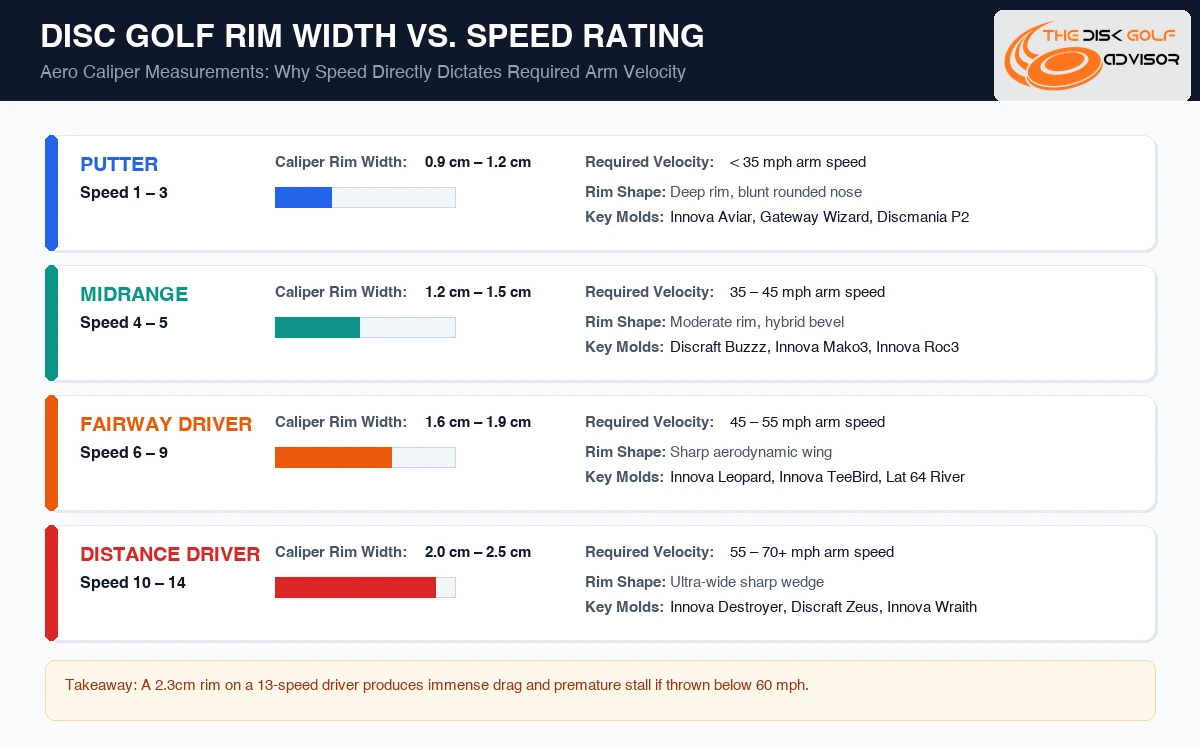
Figure 2: Precise caliper measurements across disc categories. As rim width expands past 2.0cm, required launch velocity climbs above 55 mph.
The Caliper Test: Rim Width Across Disc Categories
Taking digital calipers to our retail test discs illustrates how rim width determines the speed bracket:
- Putters (Speed 1 – 3 | Rim Width 0.9cm – 1.2cm): Deep, blunt profile designed for hand comfort, chain grabbing, and straight trajectories under 200 feet. Molds like the Innova Aviar (Speed 2, 0.9cm rim) require only 25 to 35 mph of launch velocity to achieve neutral flight. To see which putter rim profiles best match your hand size and putting style, check our hands-on review of the Best Disc Golf Putters.
- Midranges (Speed 4 – 5 | Rim Width 1.2cm – 1.5cm): Moderate rim width with a gentle beveled wing. The legendary Discraft Buzzz (Speed 5, 1.2cm rim) is the ultimate form teacher, demanding 35 to 45 mph of arm speed to hold any release angle cleanly. For complete beginner bags, neutral midranges form the core of our recommended 7 Best Disc Golf Discs for Beginners.
- Fairway Drivers (Speed 6 – 9 | Rim Width 1.6cm – 1.9cm): Aerodynamic, moderately sharp wing that balances distance potential with pinpoint fairway placement. Molds like the Innova Leopard (Speed 6, 1.6cm) and TeeBird (Speed 7, 1.7cm) represent the sweet spot for throwers generating 40 to 52 mph arm speeds.
- Distance Drivers (Speed 10 – 14 | Rim Width 2.0cm – 2.5cm): Ultra-wide, sharp aerodynamic wedges designed for maximum velocity penetration. The Innova Destroyer (Speed 12, 2.2cm rim) demands 58 to 68 mph of clean release speed to engage its high-speed turn. If you want to know when your throwing mechanics are ready for high-speed molds, read our comprehensive guide on the Best Distance Drivers for Beginners: When and How to Step Up.
The Beginner “Speed Trap” Explained
When an inexperienced thrower with 38 mph arm speed launches a 13-speed driver designed for 65 mph, the disc never reaches the airflow velocity required for high-speed turn. Instead of executing a full S-curve, the wide rim creates immediate lift imbalance. The disc noses up, stalls out in mid-air, and dumps violently into an early hyzer crash. A player throwing a 6-speed fairway driver will consistently outdrive their 13-speed driver by 40 to 70 feet simply because their arm velocity matches the disc’s aerodynamic profile.
Matching Disc Speed to Your Real-World Distance
Rather than guessing which speed rating fits your throwing form, use this empirical distance benchmark developed from our local coaching clinics:
| Maximum Controlled Distance | Estimated Arm Velocity | Recommended Disc Speed Bracket | Ideal Mold Examples |
|---|---|---|---|
| Under 200 Feet | 25 – 35 mph | Speed 1 to 4 | Innova Aviar, Innova Mako3, Discraft Buzzz |
| 200 to 275 Feet | 35 – 45 mph | Speed 5 to 7 | Innova Leopard, Latitude 64 River, Axiom Crave |
| 275 to 350 Feet | 45 – 55 mph | Speed 7 to 9 | Innova TeeBird, Discraft Undertaker, Valkyrie |
| 350+ Feet | 55 – 68+ mph | Speed 10 to 14 | Innova Wraith, Innova Destroyer, Discraft Zeus |
Field Drill: Marcus Vance’s 3-Disc Arm Speed Diagnostic
If you want to definitively uncover your true arm speed without expensive radar guns, grab three specific discs and head out to an open soccer or baseball outfield:
- Disc 1: A neutral 5-speed midrange (Discraft Buzzz or Innova Mako3).
- Disc 2: A neutral 7-speed fairway driver (Innova TeeBird or Latitude 64 Explorer).
- Disc 3: A standard 12-speed distance driver (Innova Destroyer or Discraft Zeus).
Warm up thoroughly, then throw each disc five times on a clean, flat, level release plane (zero hyzer, zero anhyzer). Measure where each disc lands:
- If your 5-speed midrange and your 12-speed driver both land at roughly 220–240 feet: Your launch velocity is under 42 mph. The 12-speed driver is stalling early due to excessive rim width drag. Remove drivers above Speed 7 from your bag and focus on throwing 5-speed and 7-speed molds until your distance passes 280 feet.
- If your 7-speed fairway out-carries your midrange by 35+ feet, but your 12-speed driver hooks hard left at 260 feet: Your launch velocity is roughly 45–50 mph. Speed 7 to 9 control drivers represent your absolute distance ceiling.
- If your 12-speed driver executes a gentle rightward turn, glides, and carries 350+ feet before fading: Your launch velocity exceeds 58 mph. You possess the required mechanical speed to command modern wide-rim distance drivers.
3. Glide (1 to 7): Aerodynamic Lift, Dome & Hang Time
Glide measures the disc’s ability to maintain aerodynamic lift during its forward travel. Rated on a scale from 1 to 7, glide indicates how long a disc stays suspended in the air once release velocity begins to decay.
Aerodynamic lift in a golf disc functions via Bernoulli’s principle and camber line geometry. As air flows over the curved upper flight plate (the dome), it travels faster than the air passing under the flat bottom, creating a low-pressure zone above the disc. Discs with a pronounced upper dome generate substantial lift, floating effortlessly on mild air currents.
High Glide (5 to 7): Maximum Forward Carry
Discs rated with 5, 6, or 7 glide are engineered for effortless forward carry. The Latitude 64 River (7 / 7 / -1 / 1) and Dynamic Discs Escape (9 / 5 / -1 / 2) represent classic examples of high-glide engineering. When thrown with proper nose-down orientation, high-glide discs stay aloft long after their primary forward thrust has dissipated, yielding bonus distance on calm fairways and tailwind drives.
However, high glide is a double-edged sword. In a stiff 15 mph headwind, a high-glide disc catches the oncoming air beneath its wing, balloons upward into the sky, loses forward momentum, and stalls uncontrollably off the fairway.
Low Glide (1 to 3): Wind Penetration and Target Precision
Low-glide discs, such as the cult-favorite Kastaplast Berg (1 / 1 / 0 / 2) or Innova Pig (4 / 1 / 0 / 3), feature flat or slightly sunken puddle-top flight plates. These molds deliberately shed aerodynamic lift, dropping out of the sky like a stone once their initial momentum fades.
Low glide offers tremendous tactical value for approach shots inside 200 feet. When throwing toward an elevated basket or a green bordered by water hazards, a low-glide approach disc eliminates the risk of catching an unexpected gust of wind and floating 40 feet past the target. You can commit to a firm throwing stroke knowing the disc will hit the turf and stop.
The “Pop-Top” Dome Check
When selecting discs off a retail rack, press your thumb firmly against the center of the flight plate. If the plastic yields with an audible “pop” and features a high, rounded arch, you are holding a high-glide disc that will excel on calm distance lines. If the flight plate is board-flat, the disc will possess lower glide, higher wind resistance, and earlier fade.
4. Turn / High-Speed Stability (-5 to +1): The Initial Flight Arc
Turn, also referred to as High-Speed Stability (HSS), measures the disc’s tendency to bank to the right (on an RHBH release) during the first portion of its flight, when the disc experiences maximum rotational spin and velocity.
The turn scale ranges from +1 down to -5. Unlike standard grading scales where positive numbers indicate strength, the turn scale uses negative numbers to represent rightward lateral drift:
- +1 to 0 (Overstable Turn): The disc strongly resists banking right. Even when launched with high arm speed into a mild breeze, it holds a straight line before fading early. Examples: Innova Firebird (9 / 3 / 0 / 4) and Discraft Zone (4 / 3 / 0 / 3).
- -1 to -2 (Mild Turn / Neutral): The disc drifts gently rightward during high-speed cruise before stabilizing. This gentle high-speed turn creates the classic straight-line flight path of discs like the Innova Leopard (6 / 5 / -2 / 1) and Discraft Buzzz (5 / 4 / -1 / 1).
- -3 to -5 (Heavy Understable Turn): The disc turns aggressively to the right early in flight. Discs like the Latitude 64 Diamond (8 / 6 / -3 / 1) or Innova Mirage (3 / 4 / -3 / 0) allow slower-arm throwers to achieve sweeping S-curves without forcing an unnatural release angle.
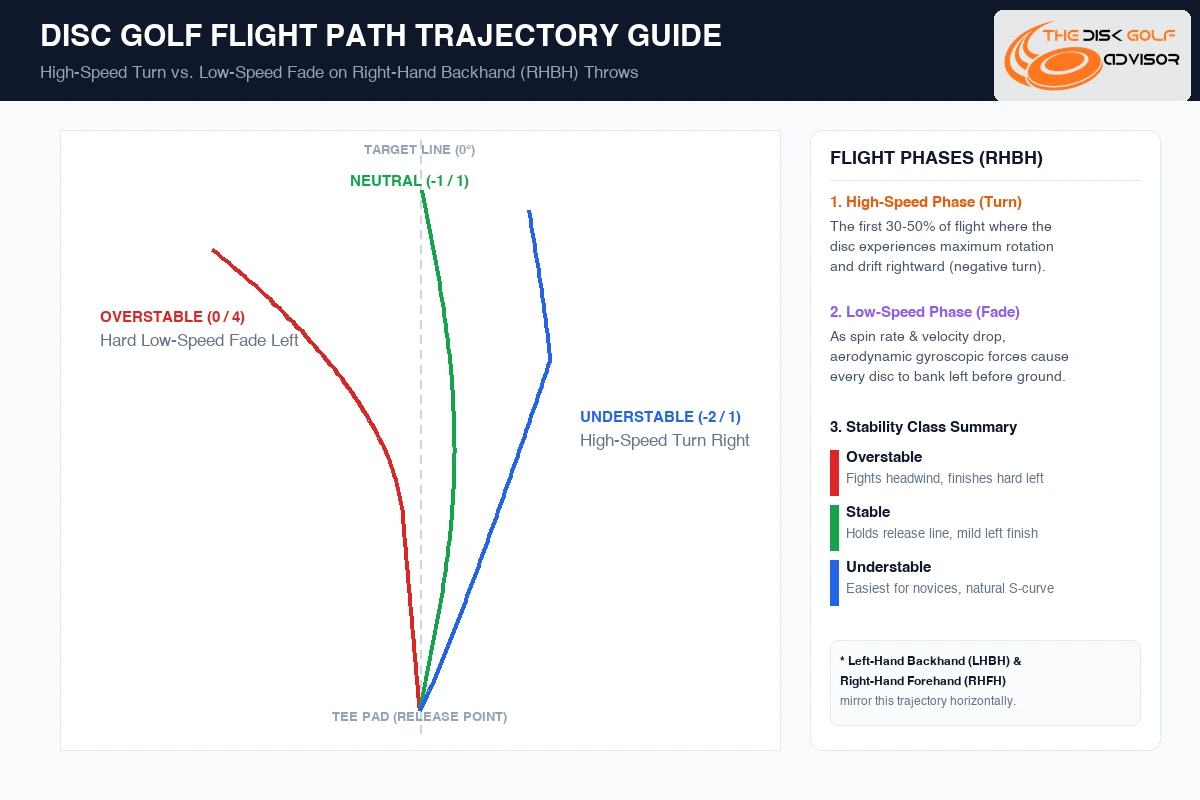
Figure 3: The three phases of disc golf flight on a flat RHBH release: high-speed turn dominates the first 40% of flight; low-speed fade takes over as rotation decays.
What Is Understable in Disc Golf? (And the Magic of the Hyzer Flip)
A disc with a turn rating of -2 or lower is categorized as understable. For beginners, understable discs are essential equipment because slower throwing speeds naturally make all discs behave more overstable. Throwing an understable mold compensates for limited release velocity, keeping the disc airborne along a straight line rather than crashing immediately to the ground.
For intermediate and advanced players, understable discs unlock one of the most powerful shots in disc golf: the hyzer flip. By releasing an understable disc on an angled downward hyzer tilt, the disc’s natural high-speed turn forces it to rotate up to a flat plane mid-flight. It lasers dead straight down narrow wooded corridors before gently setting down with minimal fade. Mastering understable fairway drivers is the primary recommendation in our Beginner Distance Driver Field Guide.
Diagnosing Off-Axis Torque (OAT) vs. True Disc Turn
Many novice throwers notice their brand-new neutral midrange turning into a rapid roller on every release, leading them to assume the disc is “too understable.” In reality, this is almost always caused by Off-Axis Torque (OAT)—rolling the wrist over during release so the plane of arm motion conflicts with the plane of the disc. True disc turn is smooth, gradual, and accompanied by clean, high-speed spin. OAT produces visible mid-air flutter, disc wobble, and an immediate downward dive.
Generating clean, wobble-free snap requires solid footing on the tee pad. If your brace foot slips on slick concrete or morning mud during your final plant step, your upper body compensates by rolling the wrist over, inducing severe off-axis torque. For field testing of traction across wet Midwest courses, see our review of the Best Waterproof Disc Golf Shoes for Wet Courses.
5. Fade / Low-Speed Stability (0 to 5): The Terminal Hook
Fade, also known as Low-Speed Stability (LSS), measures the disc’s natural tendency to hook to the left (RHBH) as forward velocity and rotational speed decay near the end of the flight.
Rated on a scale from 0 to 5, fade represents the terminal phase of every golf shot. As the disc slows down, gyroscopic precession causes the nose of the disc to tilt, forcing the wing to drop and steering the disc leftward toward the ground:
- Fade 0 to 1 (Mild Finish): The disc settles straight down onto the turf with virtually no lateral skip. Molds like the Innova Mako3 (5 / 5 / 0 / 0) and MVP Glitch (1 / 7 / 0 / 0) are renowned for holding dead-straight landing vectors. Straight-finish putters are ideal for home putting drills; see our guide on Best Disc Golf Baskets for Home Practice.
- Fade 2 (Moderate Reliable Hook): The standard finish on all-purpose fairways and workhorse midranges. The disc finishes 15 to 25 feet left of the center line with a gentle slide. Example: Innova TeeBird (7 / 5 / 0 / 2).
- Fade 3 to 5 (Aggressive Spike & Flare Skip): The disc cuts hard into the ground at a steep angle. Discs like the Innova Firebird (Fade 4) and Discraft Force (Fade 5) produce massive directional changes and dramatic ground skips off hard-packed dirt or dry grass.
What Is Overstable in Disc Golf? (Ground Action Physics and Skip Height)
Fade rating does not simply dictate where the disc lands; it dictates how the disc interacts with the turf upon landing. Discs with blunt lower lips and low fade ratings absorb impact and stay put. Discs with sharp, wide beveled wings and high fade ratings (Fade 3+) strike the turf on a severe angle of hyzer. If the fairway consists of short-cut turf or hard-packed clay, that sharp edge creates an elastic bounce known as a flare skip, kicking the disc an additional 30 to 50 feet laterally.
6. Overstable vs Understable: The Disc Golf Stability Spectrum Decoded
When evaluating overstable vs understable disc golf flight characteristics, players are assessing the combined interaction between high-speed turn and low-speed fade across the entire flight arc.
The Pro “Turn + Fade” Net Stability Shortcut
Touring professionals and experienced equipment testers do not look at turn and fade in isolation. We use a simple mental shortcut called the Net Stability Formula:
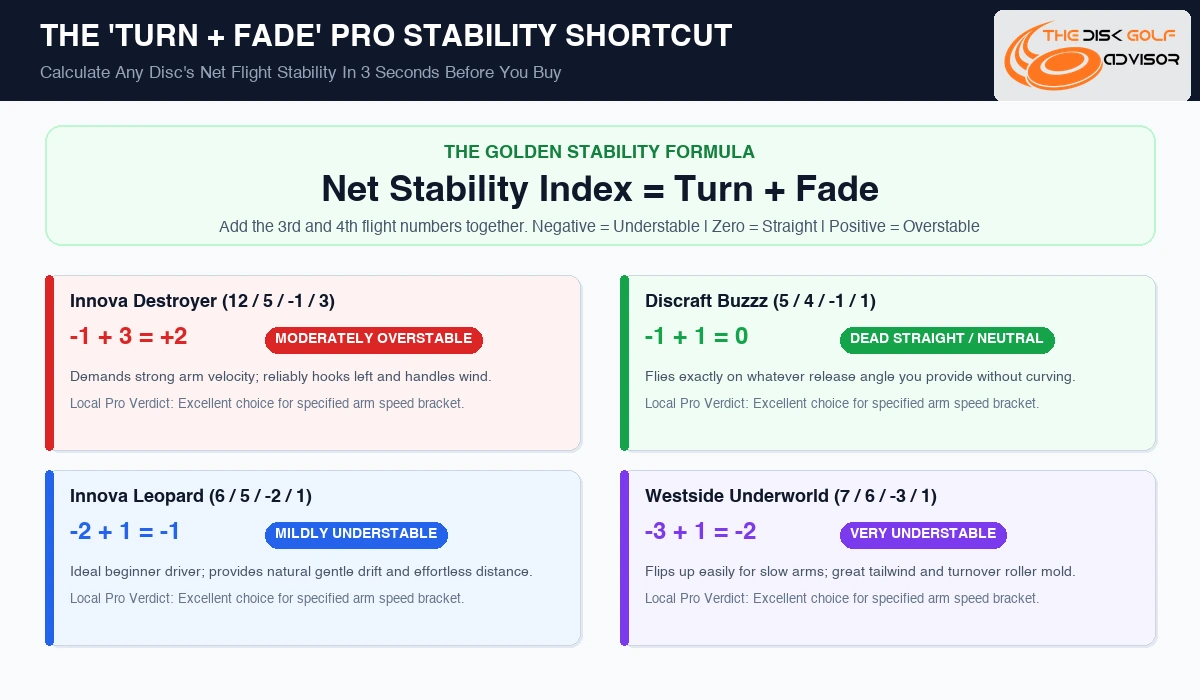
Figure 4: The Net Stability shortcut formula: add Turn and Fade together to immediately calculate whether a disc is understable, neutral, or overstable.
By simply adding the 3rd number (Turn) and the 4th number (Fade) together, you produce a Net Stability Index that instantly categorizes the mold:
| Net Stability Index (Turn + Fade) | Stability Category | Typical Flight Shape (RHBH) | Classic Mold Examples |
|---|---|---|---|
| -4 to -2 | Very Understable | Aggressive right turn; finishes right of center or rolls | Innova Mirage (-3), Westside Underworld (-2) |
| -1 | Mildly Understable | Gentle right drift, soft flat finish; ideal beginner driver | Innova Leopard (-1), Latitude 64 River (0) |
| 0 | Neutral / Dead Straight | Holds release angle with zero turn and minimal fade | Discraft Buzzz (0), Innova Mako3 (0) |
| +1 to +2 | Stable to Moderately Overstable | Resists turning; dependable left finish in moderate winds | Innova TeeBird (+2), Innova Destroyer (+2) |
| +3 to +5 | Very Overstable / Utility | Immediate left hook; fights heavy headwinds; big skips | Innova Firebird (+4), Discraft Zone (+3) |
Comparing Manufacturer Rating Systems
While the four-number system has become the universal standard, understanding brand variations prevents expensive surprises:
- Innova Champion Discs (4 Numbers): The benchmark standard. Innova ratings assume brand-new Star plastic thrown at maximum designated speed.
- Discraft (4 Numbers + Decimal Rating): Modern Discraft discs display the standard four numbers, but they also feature an older single-digit decimal stability rating (e.g., 0.0 for the Buzzz, 1.7 for the Crank, 2.5 for the Predator). A rating of 0.0 represents dead straight, negative numbers indicate understability, and numbers above 1.5 indicate heavy overstability.
- Trilogy (Dynamic Discs, Latitude 64, Westside): Uses the standard four numbers. Trilogy discs historically fly slightly more understable than their stamped turn ratings suggest, particularly in baseline Retro or Prime plastics.
- MVP & Axiom (Gyro Overmold): MVP discs feature dense outer polymer rims (Gyro technology) that increase rotational inertia. Because more mass is concentrated along the outer edge, MVP discs hold their release angle longer before initiating their fade, often flying slightly more stable than comparable single-piece molds.
For an in-depth brand-by-brand comparison of manufacturing tolerances and plastic durability, read our full breakdown of The Best Disc Golf Brands: Innova vs. Discraft vs. Dynamic Discs Compared.
7. Master Disc Golf Flight Chart: Popular Molds by Slot
To help you assemble a well-balanced bag with disc golf flight numbers explained across every flight slot, here is our master disc golf flight chart organizing the most popular tournament-proven molds by speed class and net stability:
| Category | Mold Name | Brand | Flight Numbers | Net Stability | Best Arm Speed | Primary Course Role |
|---|---|---|---|---|---|---|
| Putter | Aviar | Innova | 2 / 3 / 0 / 1 | +1 (Neutral) | All Arm Speeds | Classic point-and-shoot putting & short straight approaches |
| Putter | Envy | Axiom | 3 / 3 / 0 / 2 | +2 (Overstable) | All Arm Speeds | Tour-proven driving putter that resists torque and headwind |
| Approach | Zone | Discraft | 4 / 3 / 0 / 3 | +3 (Overstable) | All Arm Speeds | Forehand approach staple with aggressive low-speed fade |
| Midrange | Mako3 | Innova | 5 / 5 / 0 / 0 | 0 (Dead Straight) | Novice to Pro | Lasers dead straight on release line with zero skip |
| Midrange | Buzzz | Discraft | 5 / 4 / -1 / 1 | 0 (Neutral) | All Arm Speeds | The gold standard all-purpose midrange for any angle |
| Midrange | Roc3 | Innova | 5 / 4 / 0 / 3 | +3 (Overstable) | Intermediate to Pro | Reliable headwind midrange with firm hyzer finish |
| Fairway Driver | Leopard | Innova | 6 / 5 / -2 / 1 | -1 (Understable) | Beginner to Intermediate | Effortless beginner distance driver and wooded hyzer-flip mold |
| Fairway Driver | River | Latitude 64 | 7 / 7 / -1 / 1 | 0 (Glider) | Beginner to Intermediate | Massive float for tailwind drives and smooth 250ft glides |
| Fairway Driver | TeeBird | Innova | 7 / 5 / 0 / 2 | +2 (Stable) | Intermediate to Pro | The most dependable fairway driver in history for straight-to-fade lines |
| Control Driver | Firebird | Innova | 9 / 3 / 0 / 4 | +4 (Overstable) | Advanced to Pro | Heavy wind utility driver, forehand flex lines, and spike hyzers |
| Distance Driver | Wraith | Innova | 11 / 5 / -1 / 3 | +2 (Stable) | Advanced (320ft+) | Controllable full-flight distance for non-pro throwing velocities |
| Distance Driver | Destroyer | Innova | 12 / 5 / -1 / 3 | +2 (Overstable) | Pro Arm (375ft+) | The professional standard distance driver for heavy wind & power |
Notice how this master disc golf flight chart pairs understable, neutral, and overstable molds in each category. Building a complete disc golf bag does not require carrying thirty discs; it requires carrying three distinct stabilities (understable, neutral, and overstable) across your putter, midrange, and fairway driver slots. To carry your quiver securely across long tournament rounds, see our tested recommendations for the Best Disc Golf Bags, or reduce spinal strain with the Best Disc Golf Carts.
8. External Factors That Alter Flight Numbers on the Course
One of the hardest lessons for developing players is realizing that flight numbers are not carved in stone. A disc stamped 7 / 5 / -1 / 2 will fly differently on a windy afternoon in November than on a calm morning in July. Five environmental and mechanical factors actively alter flight characteristics:
8.1 Headwinds vs. Tailwinds: Calculating Real-World Airspeed
When you throw into a 15 mph headwind, the effective airspeed passing over the disc equals your throw speed plus the wind speed. Launching a disc at 45 mph into a 15 mph headwind creates a 60 mph aerodynamic environment. This artificially increases high-speed turn, causing stable discs to fly understable and understable discs to turn into unintended rollers.
Conversely, throwing with a 15 mph tailwind reduces the effective airspeed to 30 mph. The disc behaves as if thrown under-speed: high-speed turn disappears, glide drops, and low-speed fade engages prematurely. In heavy tailwinds, always reach for more understable plastic.
8.2 Plastic Durability and “Beating In”
A disc’s flight numbers reflect its behavior straight off the factory stamping press. As you play rounds on wooded courses like McNaughton Park, your disc repeatedly collides with tree trunks, gravel cart paths, and metal basket rims. These impacts cause the lower rim bead to compress and micro-scuff, slightly lowering the outer wing edge.
This physical aging process is known as beating in. Over time, every beat-in disc gains high-speed turn and loses low-speed fade. A baseline DX or Prime driver that began its life as a stable 7 / 5 / 0 / 2 will eventually beat in to fly like a 7 / 5 / -2 / 1. Premium polymers (such as Innova Champion, Discraft Z, or Latitude 64 Opto) retain their factory flight numbers for multiple seasons, while baseline plastics beat in within a dozen rounds.
8.3 How Plastic Grade Shifts Factory Flight Ratings (The Plastic Offset Rule)
One of the most eye-opening discoveries for developing players is realizing that two discs pressed from the exact same mold can fly with completely different stabilities depending on the plastic blend. Manufacturers print the exact same four flight numbers across all plastic variations of a given model, but the cooling rate and chemical composition of each polymer alters the final dome height, wing shrinkage, and parting line height (PLH).
At our testing grounds, we categorize plastics into three distinct functional tiers:
| Plastic Tier | Major Brand Examples | Grip & Durability Profile | Stability Offset Compared to Flight Stamp | Best Course Role |
|---|---|---|---|---|
| Baseline Polymers | Innova DX, Dynamic Prime, Discraft Pro-D, Latitude Retro | Maximum chalky finger traction in wet or cold weather; low impact resistance. | -1 Stability (More Understable). Beats in rapidly after 5–10 rounds. | Putting putters, cold-weather rounds, and beginner fairway drivers. |
| Mid-Grade / Recycled | Innova Pro, MVP Electron, Kastaplast K2, Prodigy 350G | Enhanced grip with moderate impact resilience; gradual, predictable wear. | True-to-Stamp Stability. Excellent grip with manageable seasoning. | All-weather throwing putters and cycle-midranges. |
| Premium Transparent Polymers | Innova Champion, Discraft Z, Latitude Opto, Prodigy 400 | Extreme structural rigidity; withstands direct 40 mph tree strikes with zero warping. | +1 to +2 Stability (More Overstable). Retains flight numbers for 3+ years. | Headwind drivers, skip shots, and rocky, wooded courses. |
| Premium Grippy Opaque Polymers | Innova Star, Discraft ESP, Latitude Gold, MVP Neutron | Silky tackiness combined with high polymer durability; gold standard for pro drivers. | True-to-Stamp Stability. Yields ideal high-speed turn and long-term glide. | Primary workhorse distance and fairway drivers off the tee. |
The Pro Takeaway: If you purchase an Innova Leopard (6 / 5 / -2 / 1) in baseline DX plastic, expect it to display a true -2 turn and beat into a -3 turnover mold within a month. If you buy that exact same Leopard in ultra-durable Champion plastic, it will fly with closer to -0.5 turn and +2 fade out of the box until thrown for dozens of rounds.
8.4 Elevation and Air Density: High-Altitude Overstability
If you live or travel to high-altitude courses in Colorado, Utah, or Arizona (4,000+ feet above sea level), the air is significantly less dense. Thinner air produces less aerodynamic lift and reduces the high-speed turning effect. Every disc in your bag will behave approximately one to two stages more overstable at high elevation. Players competing in mountain tournaments routinely switch their primary drivers to understable molds to achieve standard flight paths.
8.5 Disc Weight Physics: 150-Class vs. Max Weight 175g
A lighter disc (150g to 165g) requires less kinetic energy to accelerate, allowing throwers to generate higher release velocity and cleaner snap. Consequently, lighter discs display noticeably more high-speed turn. Heavier discs (173g to 175g) possess greater mass, resisting wind deflection and requiring higher arm speeds to turn over. For an empirical breakdown of how grams alter launch velocity, chain mechanics, and wind drift across putters, midranges, and drivers, explore our comprehensive Disc Golf Disc Weight Guide.
When practicing wind compensation and stability changes, practicing at home on an open practice layout accelerates your learning curve. Check our layout guidelines in Where to Place a Disc Golf Basket for Practice: 4 Distances & Safety Angles.
9. Frequently Asked Questions About Disc Golf Flight Numbers
01
What do the 4 numbers on a disc golf disc mean?
What do the 4 numbers on a disc golf disc mean?
The four numbers stamped on a disc golf disc represent Speed, Glide, Turn, and Fade. They describe how the disc moves through the air when thrown flat with sufficient rotational speed. Speed (1 to 14) measures aerodynamic rim width and required arm velocity. Glide (1 to 7) measures aerodynamic lift and hanging time. Turn (+1 to -5) measures the disc’s tendency to bank rightward early in flight. Fade (0 to 5) measures the disc’s tendency to hook leftward as it slows down.
02
What does a negative turn number mean in disc golf?
What does a negative turn number mean in disc golf?
A negative turn number indicates that the disc is understable during its high-speed cruising phase. For a Right-Hand Backhand throw, negative turn causes the disc to drift or bank to the right before fading back left. The more negative the number (such as -3, -4, or -5), the more aggressively the disc will turn right. Beginners benefit greatly from negative turn numbers because they compensate for slower release speeds and keep the disc flying straight.
03
What is the difference between overstable and understable?
What is the difference between overstable and understable?
On a flat Right-Hand Backhand release, an understable disc (Turn -2 to -5, low Fade) turns right during high speed, making it forgiving for beginners and excellent for hyzer-flip distance. An overstable disc (Turn 0 to +1, Fade 3 to 5) resists turning right, fights through headwinds, and hooks aggressively to the left at the end of its flight. Neutral or “stable” discs fly straight and hold whatever release angle you provide.
04
Why don’t high-speed drivers fly further for beginners?
Why don’t high-speed drivers fly further for beginners?
High-speed drivers (Speed 11 to 14) feature wide, sharp rims (2.1cm to 2.5cm) engineered to penetrate air at 60+ mph. When thrown by a beginner with 35 to 45 mph arm speed, the wide rim generates massive aerodynamic drag. Without sufficient forward velocity, the disc cannot create high-speed lift, causing it to nose upward, lose momentum, and crash violently to the left at 180 feet. Beginners consistently achieve greater distance throwing 6-speed or 7-speed fairway drivers.
05
How does Discraft’s flight rating system compare to Innova’s?
How does Discraft’s flight rating system compare to Innova’s?
Most modern Discraft discs now print the universal four-number system on the flight plate alongside Innova. However, Discraft also uses a proprietary single-number decimal stability rating. A Discraft rating of 0.0 represents a dead-straight neutral flight (like the Buzzz). Negative ratings (like -0.5 on an Archer) mean understable. Positive ratings above 1.5 (like 2.5 on a Predator) indicate heavy overstability. Discraft’s decimal rating is essentially equivalent to our Turn + Fade Net Stability formula.
06
Do flight numbers change as a disc gets beat in?
Do flight numbers change as a disc gets beat in?
Yes. Factory flight numbers reflect brand-new discs straight off the mold. Repeated tree impacts, rock scrapes, and ground collisions compress the lower rim bead and alter wing geometry. As a disc beats in, it becomes progressively more understable, gaining high-speed turn and losing low-speed fade. A veteran player can carry three copies of the exact same driver mold in different stages of wear to cover understable, straight, and overstable shots.
07
How does throwing left-handed or forehand change flight numbers?
How does throwing left-handed or forehand change flight numbers?
The numbers themselves remain identical in magnitude, but the horizontal direction mirrors. When throwing Left-Hand Backhand (LHBH) or Right-Hand Forehand (RHFH), the disc spins counter-clockwise. Consequently, high-speed turn drifts to the left, and low-speed fade hooks to the right. A disc with 0 turn and 3 fade will always finish toward the side of the disc’s rotational decay.
08
Why does my disc turn into a roller immediately?
Why does my disc turn into a roller immediately?
If your disc immediately dives into the ground and rolls on almost every throw, the cause is usually Off-Axis Torque (OAT) rather than disc understability. Rolling your wrist over at the instant of release forces the disc to spin on an axis that conflicts with its flight plane, creating severe wobble and an instant dive. To test this, throw a neutral putter or midrange smoothly on a flat line. If it flies straight without fluttering, your form is clean.
10. Final Pro Advice: Building Your Bag by Numbers, Not Marketing
The single best habit you can adopt as a disc golfer is reading flight numbers as an aerodynamic partnership with your own arm speed. Rather than chasing the newest 14-speed tournament driver endorsed by a touring champion, evaluate your current throwing velocity honestly.
Focus on mastering a three-disc core: a neutral putter (like the Innova Aviar), a laser-straight midrange (like the Discraft Buzzz), and a forgiving, understable fairway driver (like the Innova Leopard or Latitude 64 River). Once your form consistently commands those flight ratings out past 270 feet, step up to a 9-speed control driver like the TeeBird or Valkyrie. Let the flight numbers guide your progress, and you will watch your consistency skyrocket and your scores drop.