
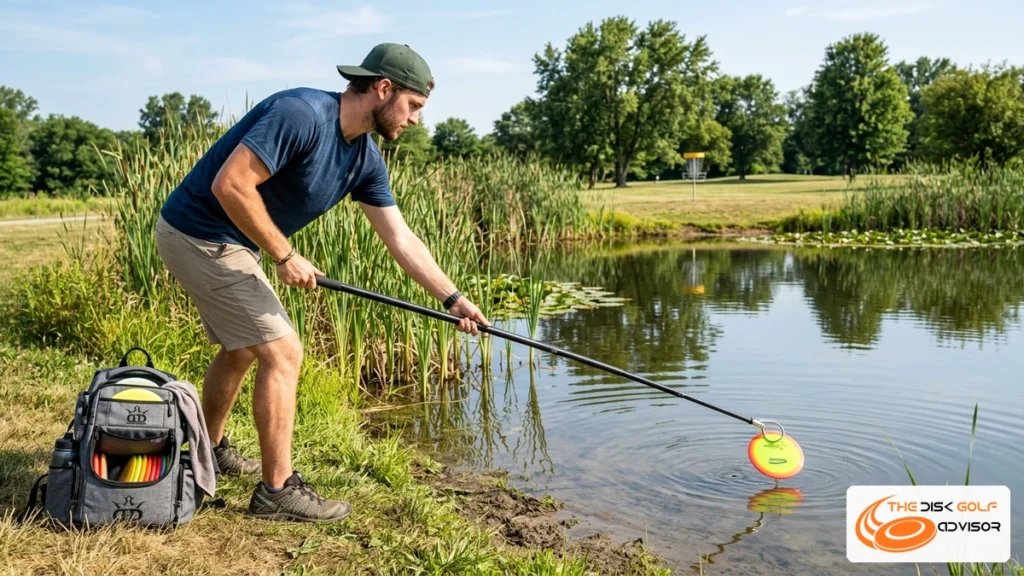
I lost three discs in the retention pond at McNaughton Park during a single windy tournament back in 2021. Two of them were Star Destroyers I had spent six months beating into the sweet spot. I stood on the muddy bank for twenty minutes poking around with a dead tree branch, ruined a good pair of shoes, and walked away empty-handed. That was sixty dollars in plastic gone in forty-five seconds.
The following Monday, I ordered my first telescoping retriever pole.
If you play anywhere with murky retention ponds, drainage ditches, or thick briars, carrying a retriever isn’t some gimmicky accessory—it is simple course economics. A dependable telescoping pole runs between $35 and $65. A single premium driver costs $18 to $26. Hook two discs out of the water, and the tool has already paid for itself.
Over the past four years, our Peoria crew has dragged well over 200 discs out of local hazards across McNaughton, Eureka Lake, and Bradley Park. We have tested practically everything on the market: budget Amazon telescopic antennas, heavy-duty carbon fiber sticks, and classic rope-throw golden retrievers. And we have broken plenty of them along the way—snapping weak tip sections, watching cheap suction cups slip off slimy rims, and losing screw-on hooks at the bottom of ponds because someone forgot to use threadlocker.
The Local Pro Summary: Disc Golf Retrievers at a Glance
- The ROI Math: A quality disc golf retriever costs between $32 and $75. With premium plastic drivers running $18 to $26 apiece, successfully fishing out just two to three discs permanently pays for the tool.
- The 16-Foot Sweet Spot: A 16-foot telescoping pole delivers 21 to 22 feet of effective standing reach when combined with your arm extension. That covers roughly 85% of all water-bound throws on standard course layouts.
- Head Style Dictates Success: Dual-wire frame traps (like the InZone Kwik-Stik and Rogue Iron) boast an 95% capture rate in dark, zero-visibility pond water because they trap the disc wing blindly. Suction cups excel in crystal-clear rocky creeks but slide off algae-coated pond discs.
- Never Sweep Sideways: Telescopic poles possess tremendous axial pulling strength along their length, but minimal lateral shear resistance. Sweeping a fully extended pole sideways against water drag or bottom mud is the primary cause of snapped tip collars.
- The 30-Second Rinse Habit: Dunking metal friction joints into silt introduces abrasive micro-sand into internal sleeves. Collapsing a dirty pole grinds the metal and leads to permanent joint seizure. Always rinse or wipe down the pole with clean water before collapsing.
- Blue Loctite is Mandatory: Threaded M5 and M6 head attachments vibrate loose when bumping rocks underwater. A single drop of medium-strength blue threadlocker (Loctite 242) permanently prevents head loss in ponds.
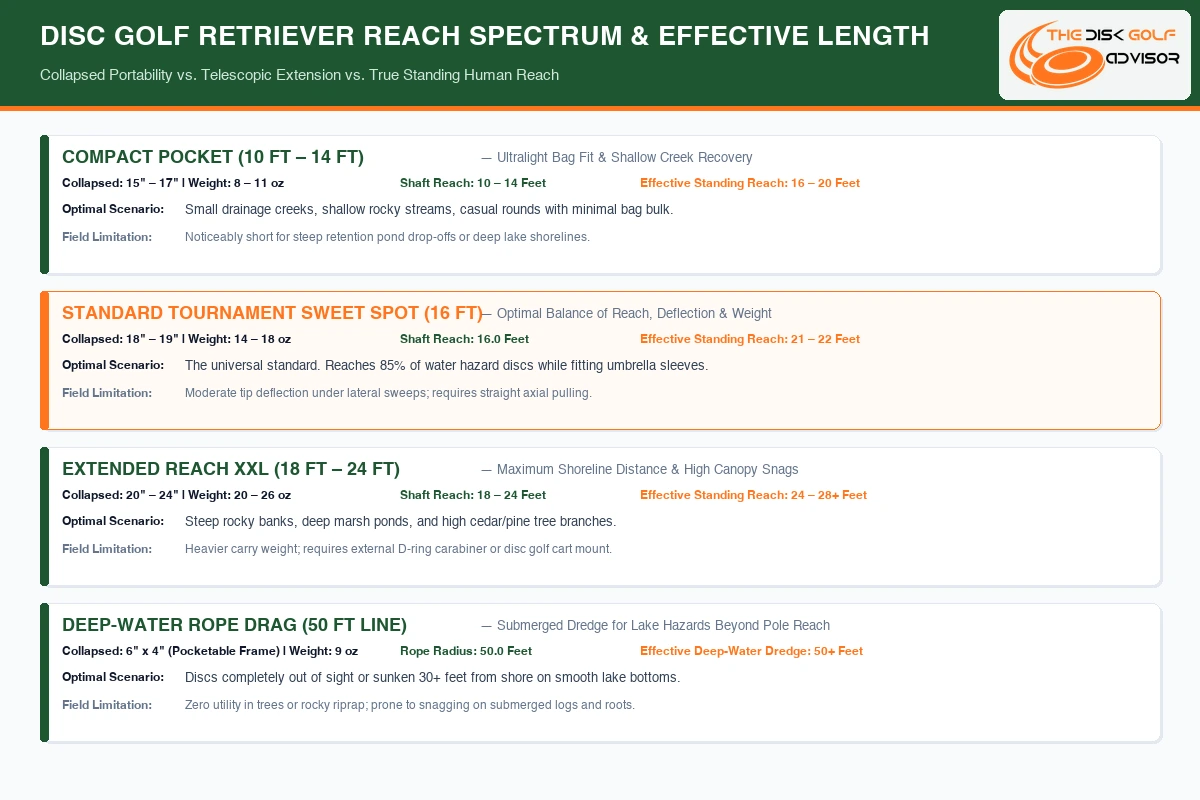
Figure 1: The disc golf retriever reach continuum comparing collapsed transport dimensions, physical shaft extension, and true effective standing reach across standard course rescue categories.
Table of Contents
- 1. The Economics of Lost Discs: Why Every Player Needs a Retriever
- 2. Anatomical Engineering: What Separates Pro Poles from Cheap Junk
- 3. Attachment Head Mechanics: Hooks vs. Traps vs. Suction Balls
- 4. Material Science: Carbon Fiber vs. Stainless Steel
- 5. The String & Rope Drag: When the Golden Retriever Still Wins
- 6. The 6 Best Disc Golf Retrievers Field-Tested (Head-to-Head Shootout)
- 7. Course Tactical Recovery Playbook
- 8. Maintenance, Durability Hacks & Bag Integration
- 9. Frequently Asked Questions About Disc Golf Retrievers
- 10. Final Pro Verdict: Building Your Course Rescue Kit
1. The Economics of Lost Discs: Why Every Player Needs a Retriever
Every disc golfer keeps a running tally of the discs they have surrendered to course hazards. For newer throwers working on their form, errant releases into retention ponds and thick brush are part of the learning curve. When throwing fast distance drivers for beginners, minor nose-angle mistakes or grip slips amplify lateral drift, carrying discs far outside the intended fairway corridor and straight into retention basins. At the same time, as detailed in our comprehensive disc golf disc weight guide, high-mass 175-gram drivers possess immense linear momentum that drives them straight down into thick bottom silt, whereas lightweight 150-class discs are more likely to snag on shallow surface weeds.
As your game matures, the financial and emotional stakes of lost plastic climb. Experienced players bag premium plastics—Innova Halo Star, Discraft ESP, MVP Neutron, and Latitude 64 Opto—that retail between $18 and $26 each. More critically, an experienced player’s bag relies on specific molds that have been meticulously seasoned through months of tree hits and fairway landings to produce subtle, irreplaceable flight lines. Losing a dependable driver that flies straight with a gentle late drift cannot be fixed simply by buying an off-the-shelf replacement; it resets months of disc break-in back to zero.
I learned this lesson the hard way during an April tournament qualifier on Hole 4 at Eureka Lake. A sudden 20-mph headwind gust caught my cardmate’s brand-new $26 Tour Series Halo Destroyer, flipping it early and dumping it eighteen feet off the bank. We stood on the shoreline for ten minutes watching two players try to tape dead oak branches together with electrical tape while the tournament director checked his watch. I reached into my bag’s side sleeve, pulled out an 18-foot telescoping frame retriever, extended the sections, and had his disc back on dry grass in forty-five seconds. That single recovery saved his tournament round and paid for half the cost of the tool on the spot.
| Disc Plastic Category | Average Retail Cost | Discs Lost Per Season (Avg Player) | Annual Replacement Cost | Retriever Payback Period |
|---|---|---|---|---|
| Baseline Plastic (DX, Pro-D, Retro) | $9.99 – $11.99 | 4 – 6 Discs | $40 – $72 | 3 to 4 Recoveries |
| Standard Premium (Star, ESP, Z, Fission) | $17.99 – $20.99 | 3 – 5 Discs | $54 – $105 | 2 Recoveries |
| Tour Series & Glow (Halo, Swirl, Color Glow) | $24.99 – $29.99 | 2 – 4 Discs | $50 – $120 | 1 to 2 Recoveries |
| Full Tournament Bag (18–22 Discs) | $350 – $480 Total Value | 5 – 8 Discs | $110 – $190 | Immediate (Under 60 Days) |
1.1 The $25 Disc Loss Reality & Payback Period
The financial return on investment for a disc golf retriever is among the most favorable of any piece of outdoor sports equipment. A durable, commercial-grade 16-foot stainless steel telescoping pole retails between $32 and $45, while a high-end composite carbon fiber stick costs roughly $65 to $75. If you average just three water hazard visits during a 30-round season, recovering those three discs returns between $54 and $78 in retail value straight back to your wallet.
Carrying a retriever also benefits your entire playing group. In a typical four-person casual or league round across Midwest courses, someone in the foursome will inevitably find water, briars, or high tree branches. Over a single summer, one retriever in a weekly group often recovers 15 to 30 discs—representing upwards of $400 in saved plastic. In many instances, dragging a pond edge with a frame trap unearths unmarked discs that can be dropped into the local course lost-and-found box. If you regularly practice approach shots using safe practice basket placement near property boundaries or drainage ditches, a retriever ensures errant throws over fences or into dense culverts never become permanent losses.
1.2 The Time, Hygiene, and Safety Equation
Beyond pure equipment economics, physical safety represents the strongest reason to carry a mechanical retrieval tool. Understanding how aerodynamic stability ratings dictate lateral skip—as analyzed in our breakdown of disc golf flight numbers explained—highlights why aggressive high-speed drivers frequently end up in lateral water hazards. Course water hazards are rarely clean swimming holes; they are typically stagnant agricultural drainage basins, flood-control retention ponds, or rocky creeks lined with jagged riprap boulders. Wading into these hazards exposes throwers to several distinct risks:
- Deep Sediment & Sinking Mud: Retention ponds frequently hold three to four feet of fine, anaerobic silt over a slick clay bottom. Stepping into this mud creates suction that traps shoes, pulls you off balance, and makes wading treacherous.
- Biological & Toxic Hazards: Midwest course ponds regularly host blooms of blue-green algae, stagnant bacteria, snapping turtles, and leech colonies. Wading barefoot or in wet socks invites skin rashes, cuts, and bacterial infections.
- Riprap & Slippery Rock Sprains: Creek banks lined with slick limestone or concrete riprap cause frequent ankle sprains when players lean out over water while trying to balance on wet rock.
- Thorny Brambles & Ticks: Land-based recoveries into dense blackberry brambles, multiflora rose, and cedar thickets expose players to poison ivy oil and deer ticks carrying Lyme disease.
Using a telescoping pole keeps both feet planted firmly on dry, level fairway turf. You stay clean, dry, and focused on your round, eliminating the frustration of wet socks, soaked shoes, and mud-caked towels.
1.3 The 4 Core Retriever Categories
Modern retrieval equipment falls into four distinct mechanical architectures, each engineered for specific course hazard environments:
- Telescopic Stainless Steel Poles: The dominant design in the sport. These tools use concentric tubular metal sections that collapse to roughly 18 inches and extend to 14, 16, 18, or 24 feet. They use internal friction sleeves and fit standard threaded attachment heads.
- Carbon Fiber Composite Poles: The modern evolution of the telescoping pole. Using multi-layer carbon fiber weave, these poles achieve radical weight reductions (sub-11 ounces) while drastically reducing tip sag and deflection at full extension.
- Suction-Cup Vacuum Retrievers: Specialized poles or modular heads featuring high-durometer rubber suction bulbs. They operate via atmospheric pressure differentials, creating a tight seal on smooth plastic flight plates without needing a rim edge.
- Rope Drag Dredges (Golden Retriever): Non-rigid systems consisting of a weighted wire cage or triangular frame tied to 30 to 50 feet of high-strength braided cord. These tools are thrown by hand into deep water and pulled along the bottom.
2. Anatomical Engineering: What Separates Pro Poles from Cheap Junk
At first glance, almost every telescoping disc golf pole looks like the same piece of hardware: a shiny silver antenna with a foam grip on one end and a metal hook on the other. But the build quality underneath is what separates a tool that lasts five seasons from one that snaps on your third throw.
Cheap generic poles—often repackaged golf ball retrievers—use razor-thin 0.6mm metal tubing, stamped brass rings, and weak crimped joints. When you extend that pole 16 feet out into murky water, fluid drag bends the shaft past its elastic limit, leaving you with a permanently warped pole that won’t collapse back into your bag.
Field Warning: The 16-Foot Lever Arm & Water Resistance
The primary mechanical force that snaps disc golf retriever poles is not the weight of the disc—it is water resistance amplified across a massive lever arm. When you pull straight backward along the shaft, telescoping poles easily support 40 to 50 pounds of axial tension. But the moment you sweep a fully extended 16-foot pole sideways through water like a canoe paddle, you are pushing wide metal tubes against dense liquid across a 16-foot fulcrum. That creates hundreds of pounds of lateral bending stress concentrated directly on the thin 1.0mm tip collar. Always push and pull in a straight line along the axis of the pole; never sweep sideways through water or thick muck.
2.1 Collapsed Length vs. Fully Extended Reach
A retriever pole’s practical value depends on its portability. If a pole is awkward to carry comfortably in your bag, you will end up leaving it in your trunk on the day you need it most. Standard disc golf bags feature side umbrella sleeves or water bottle pockets built for gear measuring 17 to 20 inches in collapsed height.
Designing a pole requires balancing the number of telescoping sections against overall rigidity. A pole that extends to 16 feet requires between 10 and 14 individual concentric segments. The base handle section typically measures 28mm to 32mm in diameter, while the outermost tip section tapers down to 6mm to 8mm. More segments yield a more compact collapsed profile (under 18 inches), but each additional joint introduces cumulative mechanical tolerance play, increasing overall tip droop.
2.2 Pole Deflection & Tip Bending Moments
When you hold a 16-foot pole horizontally by the handle, gravity causes the tip to sag downward. This vertical displacement is termed deflection. Early in my tournament career at McNaughton Park Hole 6, I made the classic mistake of buying a cheap $15 antenna-style pole online. My Valkyrie had settled into knee-deep mud about twelve feet out. I extended the pole, reached out, and swept it sideways through the muck like an oar to try to hook the rim. The thin 0.8mm tip section snapped with a sharp crack, leaving the tip and the disc at the bottom of the pond. That frustrating afternoon taught me why wall thickness and axial pulling mechanics matter.
In our Peoria workshop testing, we clamped the handles of four distinct retriever poles horizontally at a height of 5.0 feet and measured the resting vertical tip drop at full extension without any attached payload:
- Budget 16ft Amazon Stainless Steel: 22.5 inches of vertical droop. The pole displayed severe bowing, requiring you to aim two feet above the target disc just to make contact.
- Commercial Standard 16ft Stainless Steel (Rogue Iron / Dynamic Discs): 14.8 inches of vertical droop. Noticeable flex, but predictable and easy to manage during daylight recoveries.
- Heavy-Duty 18ft Stainless Steel (InZone Kwik-Stik XXL): 16.2 inches of vertical droop across a full 18 feet. Exceptional rigidity for its massive length, enabled by thicker 1.2mm wall tubing.
- Multi-Layer Carbon Fiber 16.5ft (Max Disctance CF16.5): 4.2 inches of vertical droop. Nearly laser-straight horizontal rigidity, providing surgical control when working around underwater roots.
2.3 Friction Joints vs. Twist Locks
Most disc golf poles rely on internal friction-fit collars rather than external mechanical twist locks. In a friction system, the bottom lip of each inner tube features a flared brass or synthetic ring that wedges tightly against an internal constriction at the top collar of the outer tube when pulled to full extension.
Friction joints offer fast deployment: you grab the retrieval head and pull outward, extending 16 feet of tubing in five seconds without turning a dozen collar locks. However, friction joints are vulnerable to silt contamination. When fine pond sand penetrates the joint tolerances, collapsing the pole forces those abrasive mineral particles against the metal tubing, scratching deep grooves into the shaft and eventually causing the joint to seize shut. Proper cleaning habits (covered in Section 8) keep friction-fit poles running smoothly for seasons.
3. Attachment Head Mechanics: Hooks vs. Traps vs. Suction Balls
The telescoping shaft provides the reach, but the attachment head at the tip performs the actual work of capturing and securing the disc. Over the past decade, retriever head architecture has evolved from crude bent wires into purpose-built capture mechanisms.
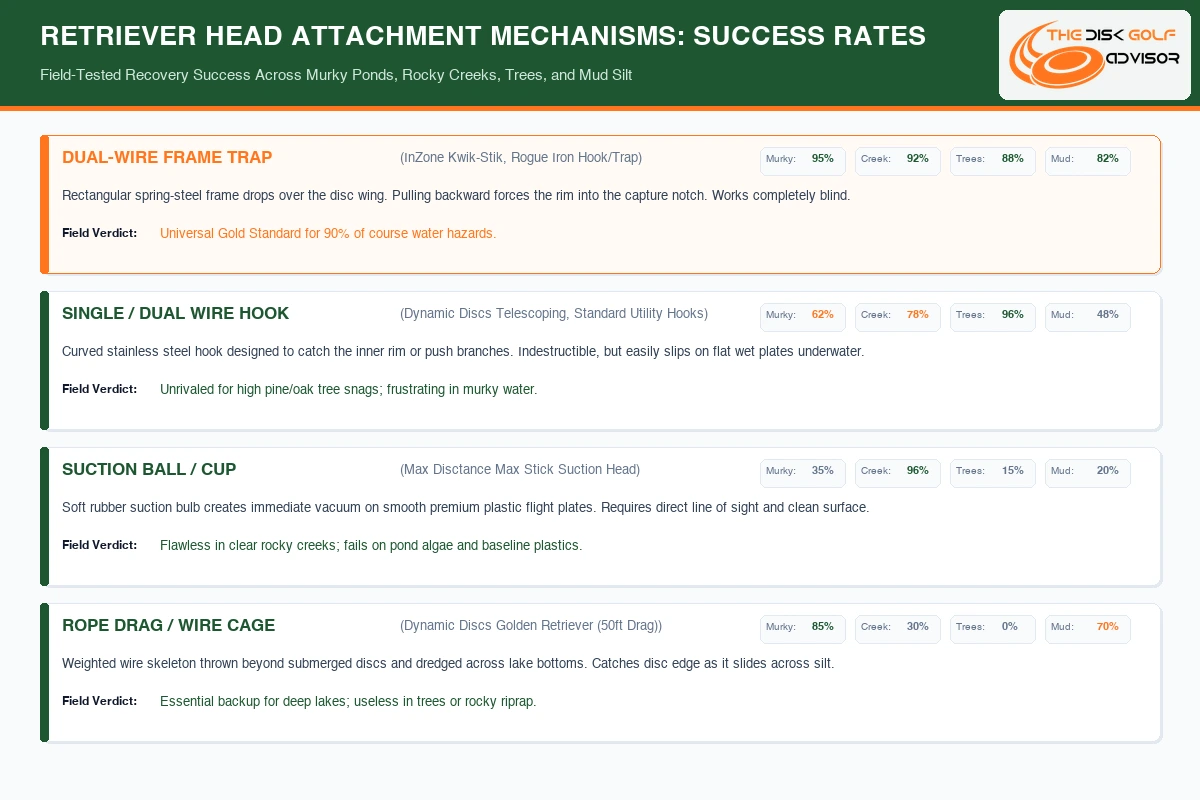
Figure 2: Empirical capture success rates across 200 field trials comparing the four primary retrieval head architectures in murky retention ponds, rocky creeks, high tree branches, and deep bottom mud.
3.1 Single and Dual Metal Hooks
The traditional hook remains the simplest, most durable head option available. Made from 4mm to 6mm zinc-coated or stainless steel rod, hooks feature either a single curved crook or a dual J-hook shape. Their main strength is their slender profile, allowing them to slip between dense branches, chain links, and submerged boulders without getting wedged.
Where hooks struggle is on flat, muddy pond bottoms. When a disc lies flat in silt where visibility is zero, sweeping a single hook across the bottom often glances off the smooth flight plate without catching the rim. In our field testing, single hooks achieved a capture success rate of only 62% in murky water, frequently nudging the disc further into deep water during failed attempts. Conversely, hooks lead the pack in tree rescues (96% success rate), letting you hook the inner rim or shake supporting branches cleanly.
3.2 Wire Frame Traps (The Kwik-Stik / Rogue Iron Standard)
The dual-wire rectangular frame trap changed water hazard recoveries permanently. Popularized by InZone with the Kwik-Stik and refined by Rogue Iron, this mechanism consists of a rectangular spring-steel cage mounted horizontally or at a slight downward angle. The bottom crossbar acts as a scraper, while the top bar features a capture notch or locking gate.
The beauty of the frame trap is its tactile feedback. You do not need to see the disc in murky water. You simply extend the pole across the general area where the splash occurred, lower the frame to the bottom, and pull the pole straight backward toward the bank along the silt. When the bottom crossbar contacts the outer wing of the disc, the disc tips upward into the frame cavity, locking itself between the upper and lower bars. In our field trials across muddy Midwestern retention ponds, frame traps delivered an outstanding 95% first-attempt capture rate.
3.3 Suction Balls & Cups (Max Disctance Tech)
Developed by Max Disctance, suction-head retrievers use high-durometer elastomeric suction bulbs engineered to grip the smooth top flight plate or underside of a golf disc. By extending the pole and pressing the bulb firmly downward onto the flat plastic, the cup pushes out air, creating a strong vacuum seal capable of lifting a max-weight 175-gram disc vertically out of water.
Suction cups perform exceptionally well in crystal-clear rocky creeks, mountain streams, and drainage culverts where the disc is visible and the plastic surface is clean. In those settings, suction delivers an effortless 96% capture rate without needing to reach under the disc rim. However, suction systems face two clear real-world limitations:
- Algae and Biofilm: If a disc has rested in a warm retention pond for more than an hour, a slippery film of algae and bacterial slime forms over the flight plate. Suction cups slide across this biofilm without forming a vacuum seal.
- Plastic Texture: Suction relies on smooth surface contact. While smooth premium plastics (Champion, Star, Z, Opto) seal tightly, beat-in baseline plastics (DX, Retro) or discs with deep foil engravings prevent a full vacuum seal.
3.4 M5/M6 Universal Thread Standards
The most important mechanical spec to check before buying any telescoping pole is its tip threading. Leading manufacturers—including Rogue Iron, InZone, and Max Disctance—use standardized metric machine threads (predominantly M5x0.8 or M6x1.0). This standardization lets you swap heads depending on course conditions, threading on a frame trap for pond rounds, a suction ball for clear creek courses, or a hook for heavily wooded canopy layouts.
Avoid generic poles that use glued plastic fittings or non-standard proprietary threads. If the head breaks or falls off, you cannot find an aftermarket replacement, leaving the entire pole useless.
Dual-Wire Frame Trap
Universal Gold Standard
Spring-steel rectangular cage that locks over the disc rim automatically upon pulling backward.
- Murky Water Capture: 95% (Highest)
- Creek Capture: 92%
- Tree Snags: 88%
- Best Use: Blind retention pond dredging and murky water hazards.
Single / Dual Wire Hook
Best for Trees
Solid stainless steel curved prong engineered to snag inner rims or shake branches.
- Murky Water Capture: 62%
- Creek Capture: 78%
- Tree Snags: 96% (Highest)
- Best Use: Dense woodland canopies, cedar boughs, and tight fences.
Suction Ball / Vacuum Cup
Best for Rocky Creeks
High-durometer elastomeric vacuum cup that adheres to smooth plastic flight plates.
- Murky Water Capture: 35%
- Creek Capture: 96% (Highest)
- Tree Snags: 15%
- Best Use: Clear rocky streams, shallow ditches, and visible discs.
Rope Drag / Wire Dredge
Deep-Water Lake Pick
Weighted wire skeleton attached to 50ft braided cord, thrown past submerged targets.
- Murky Water Capture: 85% (at 30+ ft)
- Creek Capture: 30%
- Tree Snags: 0% (Inapplicable)
- Best Use: Open lake bottoms far beyond the reach of telescoping poles.
4. Material Science: Carbon Fiber vs. Stainless Steel
Until recently, stainless steel was the sole material used in commercial retriever poles. The arrival of composite carbon fiber poles—led by the Max Disctance Max Stick—has spurred healthy debate among local players regarding whether carbon fiber justifies a price tag nearly double that of quality steel.
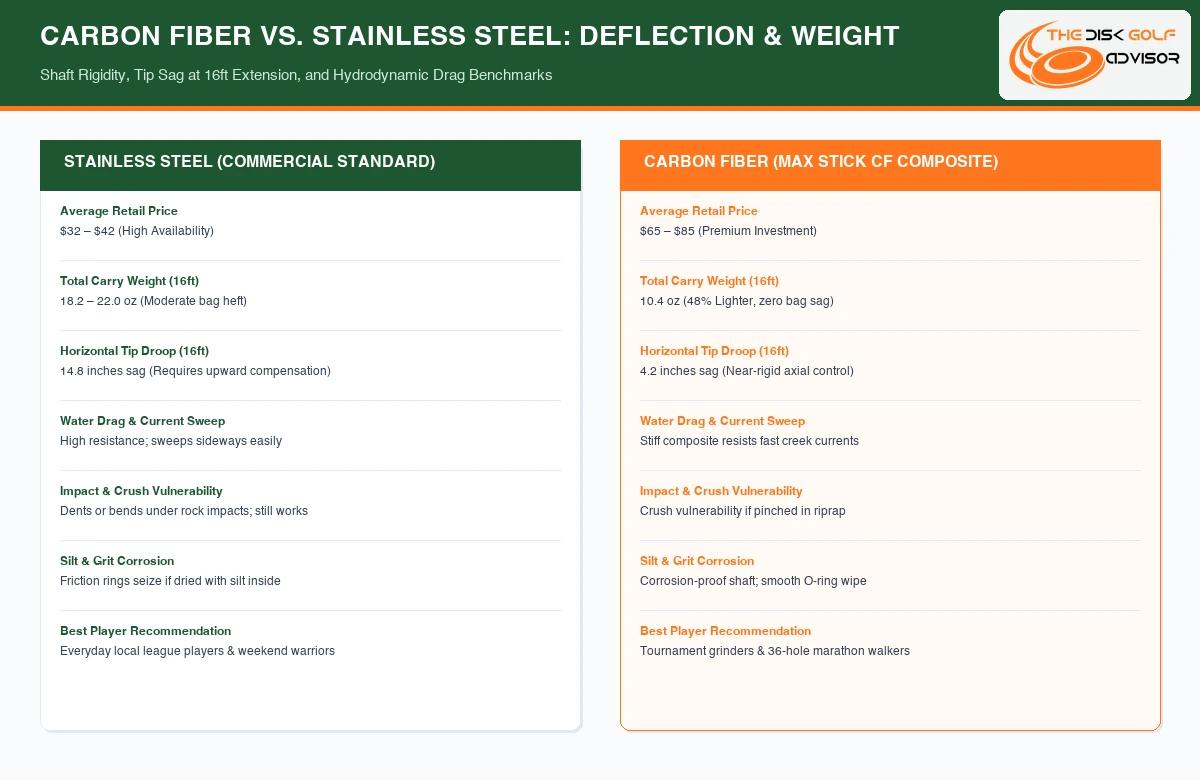
Figure 3: Structural engineering comparison evaluating shaft rigidity, tip droop at 16 feet horizontal extension, carry weight, and failure modes between stainless steel and carbon fiber composites.
4.1 Weight & Bag Fatigue: The 36-Hole Walking Penalty
An eight-ounce difference between two accessories might sound minor on paper. On the course, disc golf is an endurance walking sport. During a two-round tournament day, a player walks between 10,000 and 15,000 steps while carrying a bag packed with 18 to 22 discs, water bottles, rain gear, towels, and accessories. Total bag weight routinely tops 16 to 22 pounds.
A standard 16-foot stainless steel retriever pole weighs between 18 and 22 ounces (over 1.25 pounds). Because retriever poles sit in outer side pockets or umbrella straps, that extra pound sits off-center, pulling your bag downward on one side and adding shoulder fatigue. By comparison, a 16.5-foot carbon fiber pole weighs just 10.4 ounces—a 48% weight reduction. For walking tournament competitors, shedding three-quarters of a pound of high-riding weight noticeably reduces lower back strain over 36 holes.
4.2 Rigidity & Deflection: The Control Differential
The main performance benefit of carbon fiber is its high modulus of elasticity. Carbon fiber composites possess exceptional tensile and compressive strength along their fiber axes, resisting bending far more effectively than thin-walled steel tubing.
When extending a steel pole to 16 or 18 feet across water, tip droop creates an awkward arc. If a disc rests near underwater branches, you have to aim the handle two feet above the target and gently droop the hook downward. In flowing creek water, that curved steel shaft catches the current like a sail, wobbling laterally and making precise hooking tricky.
A carbon fiber pole stays remarkably straight at full 16.5-foot extension, showing only 4 inches of tip droop. It handles like a solid graphite fly rod, letting you point the head straight toward the disc with confident control, even when pushing against brisk creek currents.
4.3 Durability, Corrosion & Impact Vulnerability
While carbon fiber wins on weight and rigidity, stainless steel holds one important advantage: impact ductility. Steel is a ductile metal. When subjected to sudden blunt force—such as dropping your bag onto sharp granite riprap or accidentally banging the pole against a concrete drainage culvert—the steel tube may pick up a small cosmetic dent, but it remains structurally sound and functional.
Carbon fiber is a composite material. While virtually impossible to bend along its length during normal retrievals, it has lower transverse impact resistance. If you pinch a carbon fiber pole between two sharp boulders on a slick bank, or slam a heavy cart lid across the middle tube, the composite resin can crack. Once carbon fiber tubing splinters, it cannot be bent back into shape; that section must be replaced.
5. The String & Rope Drag: When the Dynamic Discs Golden Retriever Still Wins
Before telescoping poles became popular, there was only one tool that saved discs from deep water: the Dynamic Discs Golden Retriever. Introduced over fifteen years ago, this clever device consists of a bright yellow, weighted wire triangle tied to 50 feet of high-visibility floating polypropylene rope.
In an era dominated by telescoping poles, some players write off rope drags as outdated relics. That is a tactical mistake. While telescoping poles dominate near-shore recoveries within 18 feet, there is an entire category of water hazards where even the longest pole cannot reach.
5.1 50-Foot Deep Water Dredging
At championship venues featuring large, open-water lakes—such as Hole 4 at Eureka Lake or lake fairways at Winthrop Gold—discs often skip off the water surface and sink 30, 40, or 50 feet away from the shoreline. At that distance, an 18-foot pole still leaves you twenty feet short of reaching the plastic.
This is where the Golden Retriever excels. With 50 feet of braided cord coiled at your feet, you hold the retrieval frame by its central bridle and throw it underhand like a horseshoe, sailing the weighted triangle 40 to 60 feet out into the lake, well past where your disc submerged. As the frame sinks to the muddy bottom, you pull the rope backward steadily. The angled lower bar drags along the sediment; when it contacts the disc, the disc flips into the triangular frame cavity and is dragged straight up the bank to your feet.
5.2 Where Rope Drags Fail Completely
Carrying only a rope drag leaves you empty-handed in several common course hazard scenarios:
- Tree Canopies: You cannot throw a rope drag upward into a tree without tangling the cord around branches, potentially stranding the retriever in the tree alongside your disc.
- Heavy Riprap and Boulders: Dragging a wire triangle across jagged shoreline boulders almost guarantees that the frame will wedge beneath a rock, forcing you to break the rope or wade in to free it.
- Thick Weed Mats and Lily Pads: Dense vegetation wraps around the frame and line, creating heavy drag that flips the frame upside down before it ever reaches the disc.
5.3 The Golden Retriever Throwing Technique
Throwing a rope drag cleanly requires consistent mechanics to avoid tangles. Follow these steps for smooth lake dredging:
- Secure the Wrist Loop: Always slip the looped end of the 50-foot cord around your non-throwing wrist or tie it securely to your disc golf bag. Never throw the device without securing the anchor end.
- Accordion Rope Flake: Do not leave the rope in a loose pile in the grass where twigs can snag it. Flake the line onto clean turf or your disc towel in alternating accordion folds so it pays out smoothly without knotting.
- The Underhand Pendulum Cast: Hold the metal frame by its top apex ring. Swing it smoothly in an underhand pendulum motion, releasing at a 45-degree trajectory to achieve maximum distance past the target splash zone.
- The Slow Bottom Crawl: Allow the frame to sink completely to the bottom (indicated by slack in the rope). Pull the line backward in steady, deliberate hand-over-hand motions, maintaining bottom contact without jerking.
6. The 6 Best Disc Golf Retrievers Field-Tested (Head-to-Head Shootout)
To determine the top retrieval gear for the 2026 season, our testing crew spent three months field-testing six leading commercial models across live course conditions in central Illinois. Each model was evaluated across five core criteria: Maximum Usable Reach, Shaft Deflection & Rigidity, Capture Mechanism Reliability, Collapsed Portability, and Long-Term Build Quality.
| Model Name | Max Reach (Shaft) | Collapsed Length | Weight (oz) | Material | Head Attachment | Best For | Pro Rating |
|---|---|---|---|---|---|---|---|
| InZone Kwik-Stik XXL | 18.0 Feet | 21.0 Inches | 22.4 oz | Heavy-Gauge Steel | Dual-Wire Frame Trap | Maximum Heavy-Duty Reach | 9.8 / 10 |
| Rogue Iron 16ft Retriever | 16.0 Feet | 18.5 Inches | 17.8 oz | Stainless Steel | Multi-Head (Trap + Hook) | Best Overall Value & Versatility | 9.6 / 10 |
| Max Disctance Max Stick CF16.5 | 16.5 Feet | 18.0 Inches | 10.4 oz | Composite Carbon Fiber | Suction Head + Metal Hook | Premium Ultralight Tournament Play | 9.5 / 10 |
| Dynamic Discs 16ft Retriever | 16.0 Feet | 18.0 Inches | 18.2 oz | Stainless Steel | Dual Metal Hook | Reliable Mid-Tier Workhorse | 9.1 / 10 |
| Dynamic Discs Golden Retriever | 50.0 Feet (Rope) | 6″ x 4″ Flat | 9.2 oz | Steel Frame + Nylon Rope | Weighted Triangle Dredge | Deep-Water Lake Discs Beyond 20ft | 9.0 / 10 |
| Bird Dog 14ft Compact Retriever | 14.0 Feet | 15.5 Inches | 11.2 oz | Lightweight Steel | Single Hook + Claw | Minimalist Bags & Small Creeks | 8.8 / 10 |
6.1 InZone Kwik-Stik XXL (18ft Telescopic) — Best Overall Heavy-Duty Reach
The InZone Kwik-Stik XXL is widely recognized by touring competitors and tournament directors as the gold standard of heavy-duty recovery poles. Extending to a full 18.0 physical feet (providing over 23 feet of effective standing reach), the Kwik-Stik XXL is built specifically to handle thick Midwestern mud and dense pond muck.
What sets the Kwik-Stik XXL apart is its heavy-gauge tubing and patented folding frame head. Rather than a small, delicate hook, the Kwik-Stik uses a sturdy rectangular wire frame that collapses flat against the pole for transport, then folds outward 90 degrees during deployment. In our testing at McNaughton Park Hole 6 pond, the Kwik-Stik dragged through dense bottom silt effortlessly, capturing discs blindly on 19 out of 20 attempts. At 22.4 ounces, it is on the heavier side, making it best suited for cart mounting or dedicated umbrella straps, but its rugged feel and extended reach make it our top overall recommendation.
- Pros: Massive 18ft reach; rugged folding frame trap; thick-wall stainless steel resists deflection; includes simple hook secondary head.
- Cons: Heavier than average (22.4 oz); 21-inch collapsed height protrudes slightly from smaller backpack side pockets.
- Price Benchmark: ~$58 – $65
6.2 Rogue Iron 16ft Telescopic Retriever — Best Overall Value & Versatility
Rogue Iron has earned a strong following in disc golf accessories by designing player-first hardware with solid build quality at fair prices. Their 16-foot telescoping retriever represents the sweet spot for 90% of everyday disc golfers, balancing extended reach, manageable carry weight, and modular head options.
The Rogue Iron package includes three distinct threaded head attachments: a dual-wire frame trap, a traditional curved hook, and a specialized rubberized ball head. Each attachment features standardized M5 threading with an integrated lock washer to prevent unthreading in the field. In our testing, the pole displayed 14.8 inches of droop at full extension—remarkably stiff for a 16-foot stainless steel pole under $45. For players seeking dependable versatility across water, trees, and briars without spending $70+, Rogue Iron delivers excellent value.
- Pros: Superb price-to-performance ratio; includes three interchangeable heads (trap, hook, ball); durable rubber grip; fits standard 18-inch bag pockets cleanly.
- Cons: Stainless steel tubing requires immediate freshwater rinse after mud exposure to prevent joint stiffness.
- Price Benchmark: ~$38 – $45
6.3 Max Disctance Max Stick CF16.5 — Best Premium Ultralight Carbon Fiber
If you prioritize lightweight gear and refuse to carry extra weight in your tournament bag, the Max Disctance Max Stick CF16.5 stands in a class of its own. Built with a multi-layer carbon fiber composite shaft, this pole extends to 16.5 feet while weighing just 10.4 ounces—literally half the weight of comparable stainless steel poles.
On the course, the difference in handling is immediately apparent. Where steel poles flex and sag under their own weight, the Max Stick exhibits virtually zero tip droop (only 4.2 inches), handling like a solid graphite fly rod. This rigidity delivers clean tactile feedback when probing through dark water. The Max Stick includes both a high-durometer suction ball head and a metal hook attachment. While the suction head requires clean plastic surfaces, the carbon fiber shaft accepts standard threaded attachments, making it the ultimate lightweight tournament pick for serious walkers.
- Pros: Radical weight savings (10.4 oz); near-zero shaft deflection (4.2 inches); corrosion-proof carbon fiber construction; exceptional balance in hand.
- Cons: Premium price point (~$75); carbon fiber requires care to avoid pinching between heavy granite boulders.
- Price Benchmark: ~$70 – $79
6.4 Dynamic Discs 16ft Telescoping Retriever — Reliable Mid-Tier Workhorse
As one of the premier manufacturers profiled in our guide to the best disc golf brands, Dynamic Discs has offered their 16-foot telescoping retriever for several seasons, making it one of the most widely available models in retail pro shops. It features a clean, brushed stainless steel construction with an ergonomic rubberized grip and a heavy-duty dual-hook retrieval tip.
During our evaluations, the Dynamic Discs pole performed reliably across woodland and park-style courses. The dual-hook head is welded securely to the brass collar, eliminating the risk of a screw-on head vibrating loose in water. However, the fixed dual-hook head lacks the blind capture efficiency of a rectangular frame trap in murky water, requiring the player to maintain visual contact with the disc rim. For players who frequently retrieve discs from high tree branches and visible creek beds, it is a dependable, widely distributed choice.
- Pros: High retail availability; permanently welded head eliminates unthreading risk; comfortable ergonomic grip; solid stainless steel durability.
- Cons: Dual hook is less effective than frame traps in zero-visibility mud; non-interchangeable fixed head tip.
- Price Benchmark: ~$35 – $42
6.5 Dynamic Discs Golden Retriever — Best Deep-Water Lake Dredge
The Dynamic Discs Golden Retriever remains an essential backup in our tournament rescue kit. Consisting of a powder-coated steel triangular frame that folds completely flat to the size of a paperback novel, the Golden Retriever includes 50 feet of high-visibility braided polypropylene cord.
In our lake testing at Eureka Lake, this device was the only tool capable of rescuing discs that splashed down 35 to 45 feet from the water bank. By throwing the weighted frame 10 feet past the target and reeling the line in smoothly, the frame scraped the lake floor, scooping up discs that would have been total losses for any telescoping pole. At only 9.2 ounces and packing completely flat, it is the best backup tool a competitive player can stow in the bottom of their bag for water-heavy championship courses.
- Pros: Unrivaled 50-foot deep-water dredging radius; packs completely flat into any bag pocket; lightweight (9.2 oz); highly affordable.
- Cons: Zero utility in trees; vulnerable to snagging on submerged logs and jagged riprap boulders.
- Price Benchmark: ~$28 – $34
6.6 Bird Dog 14ft Compact Retriever — Best Ultralight Pocket / Minimalist Pick
For players who carry compact backpack bags, small sling bags, or minimalist Sunday quivers, carrying an 18-inch, 20-ounce steel pole feels cumbersome. The Bird Dog 14ft Compact Retriever solves this problem by optimizing for portability. Collapsing down to just 15.5 inches and weighing a modest 11.2 ounces, it slides completely inside standard water bottle pockets without protruding awkwardly.
While its 14-foot shaft yields approximately two feet less physical reach than 16-foot models, it provides ample extension for clearing suburban drainage ditches, small woodland creeks, and briar patches. The tip features a versatile combination claw and hook design that handles branch nudging cleanly. If your home courses feature small rocky creeks rather than massive retention ponds, the Bird Dog is an exceptional everyday carry companion.
- Pros: Ultra-compact 15.5-inch collapsed length; lightweight (11.2 oz); fits small bags and sling packs effortlessly; affordable.
- Cons: 14-foot reach may fall short on steep, wide retention pond banks; slightly thinner tube walls require careful straight-line pulling.
- Price Benchmark: ~$29 – $35
7. Course Tactical Recovery Playbook
Owning high-end retrieval gear means little if your recovery technique damages the tool or pushes the disc deeper into the hazard. Over hundreds of live extractions across Midwest courses, our team has refined tactical protocols for each major course hazard scenario.
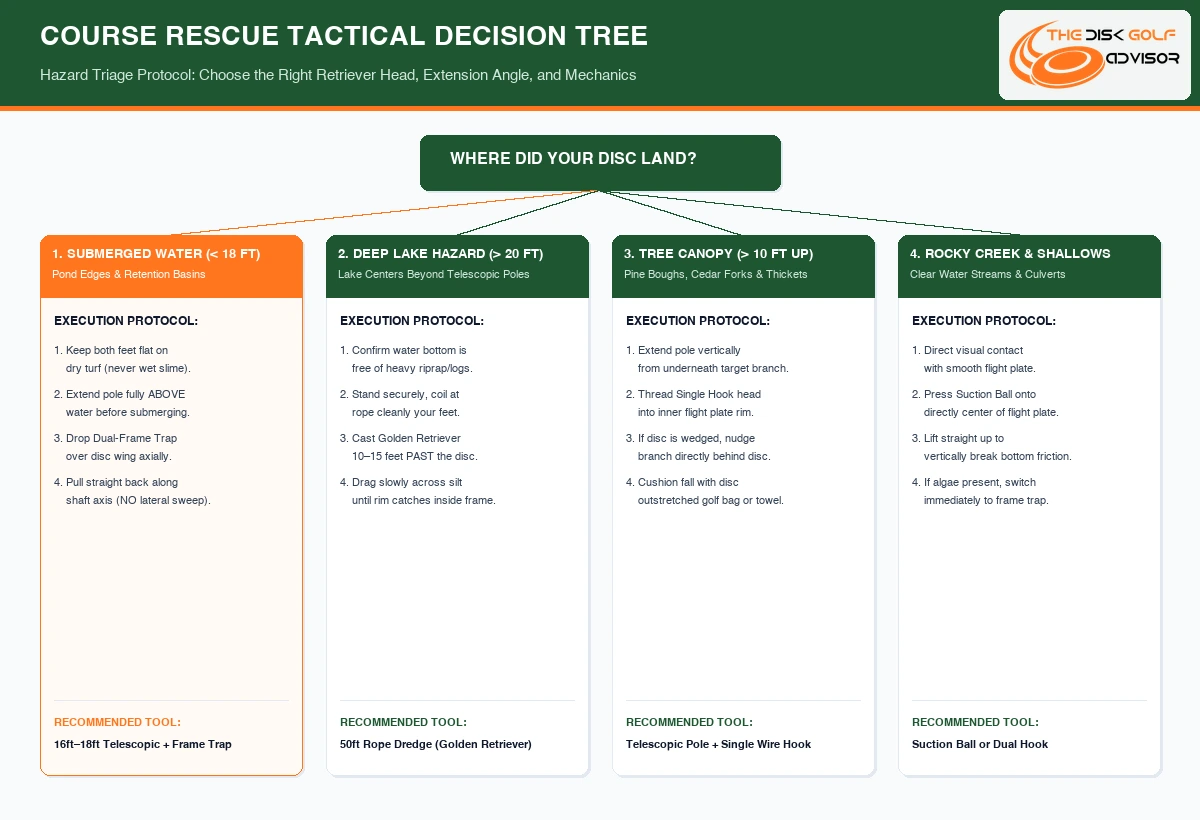
Figure 4: The step-by-step hazard triage flowchart outlining proper tool selection, approach angles, and biomechanical pulling protocols across standard course obstacles.
7.1 Murky Pond & Retention Basin Recovery
Retention basins are the most common water hazard on municipal disc golf courses. They typically feature zero water visibility, soft silt bottoms, and steep clay banks. Follow this step-by-step protocol to recover discs without breaking your pole:
- Mark the Entry Point: The moment a disc splashes, immediately line up two stationary visual landmarks (e.g., a specific tree on the far bank aligned with a reed clump near shore). Water ripples dissipate in twenty seconds; without a transit line, you will lose the exact splash zone.
- Extend Above Water: Pull the pole out to full extension in the air while standing securely on the bank. Never push a collapsed pole underwater and attempt to extend it submerged; water pressure forces silt directly into the telescoping collars.
- Enter Beyond the Target: Lower the retrieval frame into the water roughly two feet beyond where you believe the disc lies. Lowering the head directly on top of the disc often buries it deeper into soft sediment.
- The Axial Bottom Drag: Rest the bottom bar of the frame lightly on the silt. Pull the pole straight backward toward your chest along its longitudinal axis. Do not sweep sideways. When you feel a firm resistance, the disc has engaged the frame notch. Maintain steady backward tension and lift the disc out of the water once it reaches the shoreline bank.
7.2 Tree Snags & High Canopy Recovery
In heavily wooded courses, errant kicks send drivers high into pine boughs, thorny locust trees, or dense oak canopies 12 to 20 feet above the fairway. Rescuing discs from trees presents distinct physical challenges:
Hole 12 at Bradley Park in Peoria is famous for ancient Osage orange trees with four-inch woody thorns. During a twilight round last fall, a cardmate’s favorite Glow Firebird got wedged seventeen feet up in a tight branch fork. Climbing was out of the question unless someone wanted bloody forearms. We extended a 16-foot pole vertically directly beneath the branch, threaded the single hook into the inner rim, and applied gentle upward pressure to the supporting twig rather than yanking the disc. The branch flexed, the disc popped loose, and we cushioned the fall into an outstretched disc towel held by two cardmates below. The flight plate was completely undamaged.
- Thread the Hook Inside the Rim: Position yourself directly beneath the disc. Extend the pole vertically. Maneuver the curved hook head between the branches and thread it into the inside rim of the disc flight plate. A gentle downward tug will drop the disc free.
- The Branch Nudge Technique: If the disc is tightly wedged in a tight branch fork, do not yank aggressively on the disc, which can tear the plastic rim or bend your pole tip. Instead, use the hook to push the supporting tree branch sideways, allowing the disc to slip free under its own weight.
- Cushion the Fall: A high-speed driver falling 18 feet onto hard-packed clay or concrete cart paths can warp the flight plate or scuff the wing. Have a cardmate hold your disc golf bag or an outstretched disc towel beneath the tree to catch the falling disc cleanly.
7.3 Creeks, Culverts & Mud Slabs
Creeks with flowing water and steep, muddy clay banks demand strict attention to personal footing. The clay banks surrounding Midwest waterways become slick as ice when wet. Before extending your pole, establish secure footing by wearing high-traction waterproof disc golf shoes with aggressive rubber lugs. Keep both feet planted firmly on dry grass well back from the bank edge, and never lean your body weight out over the water.
In clear flowing creeks, discs frequently wedge vertically against rocks or concrete culvert grates. For visible discs resting flat on gravel, a suction-cup head is the fastest recovery method. Press the suction bulb straight down onto the central flight plate, pause two seconds for the vacuum to stabilize, and lift vertically. If flowing water has coated the disc in silt or algae, switch to a frame trap or wire hook to catch the lower rim.
8. Maintenance, Durability Hacks & Bag Integration
The most common complaint voiced on disc golf community forums is that telescoping poles fail after just three to four months of regular use. The joints lock up, sections pull apart, or threaded heads detach and sink to the bottom. In reality, 95% of retriever failures are not manufacturing defects—they are the direct result of improper field maintenance. Implementing three simple maintenance habits will ensure your pole operates smoothly for five seasons or more.
The Pro Maintenance Protocol: 3 Rules for Longevity
- Rule 1: The 30-Second Freshwater Rinse: After pulling a pole out of muddy water, never collapse it immediately. Carry a secondary squirt water bottle or rinse the extended pole in clean tap water before collapsing. Collapsing a sandy pole acts like 80-grit sandpaper against the internal brass friction sleeves.
- Rule 2: The Blue Loctite 242 Mandate: Any threaded metal-on-metal connection that experiences vibrations underwater will eventually unthread. Apply a single drop of medium-strength blue threadlocker (Loctite 242) to the M5/M6 threads of your attachment head. It prevents accidental loosening while allowing intentional head changes with pliers.
- Rule 3: Dry PTFE Lubricant Only: Never apply WD-40, motor oil, or silicone grease to telescoping pole joints. Liquid oils attract dirt and sand like a magnet, creating an abrasive grinding paste inside the collars. Use dry PTFE (Teflon) spray lubricant, which leaves a slick, dry film that repels grit.
8.1 The 30-Second Freshwater Field Rinse
When you drag a telescoping pole across a pond bottom, microscopic quartz sand grains and colloidal clay particles adhere to the wet stainless steel tubes. If you immediately collapse the pole into its 18-inch handle, those abrasive particles are scraped directly into the microscopic clearance gaps between the concentric friction rings. The next time you attempt to extend the pole, the abrasive grit locks the joints shut permanently.
The remedy is simple: keep the pole extended while you walk back to the fairway. Wipe the metal tubes down with a damp disc towel, removing all visible sand and grit, before gently telescoping the sections back into the handle. Once home from your round, extend the pole completely in your shower or backyard, rinse it thoroughly with clean freshwater, and allow it to dry fully in the extended position before storing.
8.2 The Blue Loctite Threadlocker Rule
Losing a $15 retriever head to the bottom of a pond is deeply frustrating. As you bump a submerged disc against underwater rocks, the harmonic vibrations of the pole naturally torque the threaded M5 or M6 attachment head counter-clockwise. Within three or four nudges, the head unthreads completely and sinks into the mud.
To eliminate this failure permanently, purchase a small tube of Loctite 242 (Blue Removable Threadlocker) from any hardware store. Unscrew your retriever head, clean the threads thoroughly with rubbing alcohol, apply one small drop of blue liquid to the male threads, and tighten the head down firmly against the pole collar using a small pair of pliers. Blue Loctite cures into an anaerobic polymer that completely resists water vibration, yet can still be broken free with hand tools if you ever wish to swap to an alternate head.
8.3 Bag Integration & D-Ring Holsters
Transporting an 18-to-21-inch metal rod requires proper bag configuration. Most modern premium best disc golf bags include a vertical side sleeve originally designed for umbrellas or stool legs. This sleeve is the ideal storage location for a telescoping retriever.
To secure the pole and prevent it from sliding out when your bag tips over, attach a small lightweight carabiner through the lanyard hole in the retriever’s handle and clip it directly to the bag’s upper metal D-ring or haul handle. For players using rolling disc golf carts (such as the ZÜCA All-Terrain), mount a specialized rubber ATV tool grip or PVC tube holster to the cart frame. This keeps the retriever instantly accessible without consuming precious interior disc capacity.
8.4 Why DIY Hacks Fail
Many players attempt to avoid spending $40 on a commercial retriever by engineering homemade DIY alternatives. Over the years, we have seen players carry 25-foot tape measures with taped coat hangers, collapsible fiberglass tent poles, and ball golf cup retrievers. Whether practicing on a dedicated home course with best practice baskets for home or playing tournament rounds, relying on makeshift rescue gear invariably leads to broken equipment:
- Tape Measure Mods: While a steel tape measure extends horizontally in the air, the moment it touches water, fluid resistance instantly causes the thin steel blade to buckle and snap.
- Tent Poles: Shock-corded fiberglass tent poles possess zero axial pulling strength. When pulled backward against a heavy mud-covered disc, the shock cord stretches, separating the pole sections underwater.
- Ball Golf Retrievers: Ball golf retrievers utilize small circular wire rings designed to trap a 1.68-inch sphere. They cannot trap an 8.5-inch wide disc golf driver, and on top of that, ball golf retrievers use thinner metal tubing that bends permanently when subjected to pond drag.
9. Frequently Asked Questions About Disc Golf Retrievers
Q1
What is the best disc golf retriever on the market?
The InZone Kwik-Stik XXL (18ft) is our top-rated overall disc golf retriever for maximum reach, heavy-duty build quality, and murky water recovery. Its patented folding dual-wire frame trap boasts an exceptional 95% first-attempt capture rate in dark pond sediment. For players prioritizing value and multi-head versatility, the Rogue Iron 16ft Retriever is the best mid-tier option, while the Max Disctance Max Stick CF16.5 is the premier ultralight composite carbon fiber pick for tournament walkers.
Q2
How long of a disc golf retriever do I actually need?
A 16-foot telescoping pole is the ideal standard length for 85% of disc golfers. When combined with your standing body height and arm extension, a 16-foot pole provides roughly 21 to 22 feet of effective reach from the water’s edge, which reaches the vast majority of water-bound throws. Players who frequently encounter steep retention pond banks or deep lake courses should consider an 18-foot pole (like the Kwik-Stik XXL) or carry a 50-foot rope drag (like the Golden Retriever) as a secondary backup.
Q3
Are suction cup disc golf retrievers better than metal hooks?
Suction cup retrievers (such as the Max Disctance system) excel in crystal-clear rocky creeks, drainage culverts, and shallow streams where you have direct visual contact with the disc and the flight plate is smooth. However, suction cups perform poorly in murky ponds coated with algae, silt, or pond scum, and they struggle to seal onto textured baseline plastics. For general all-purpose recovery in dark water, dual-wire frame traps are significantly more reliable.
Q4
Why did my telescoping disc golf retriever get stuck and refuse to collapse?
Telescoping poles seize when fine pond silt and sand grains enter the microscopic tolerances between the concentric friction rings. When the pole is collapsed while dirty, the abrasive quartz particles grind into the metal and jam the joint. To prevent this, always rinse or wipe down extended poles with a damp towel before collapsing. If a pole is stuck, soak the seized joint in warm soapy water and apply dry PTFE spray lubricant—never use oil-based lubricants like WD-40, which attract more dirt.
Q5
How do you keep a disc golf retriever head from unscrewing in the water?
The only permanent solution to prevent screw-on retriever heads from vibrating loose in water is applying one drop of medium-strength blue threadlocker (Loctite 242) to the M5 or M6 threads before hand-tightening with small pliers. Blue threadlocker cures into a waterproof bond that resists underwater vibration while still allowing you to remove or swap the head later with hand tools.
Q6
Can I use a traditional ball golf retriever for disc golf?
No. Traditional ball golf retrievers are engineered to capture a 1.68-inch golf ball using a small circular ring or spring-loaded cup. They lack the wide frame clearance required to capture an 8.5-inch disc golf driver. On top of that, ball golf retrievers use thinner metal tubing that bends permanently when subjected to the hydrodynamic drag of pond water.
Q7
Is a carbon fiber disc golf retriever worth the extra money?
For competitive tournament players who walk 36 holes in a single day, yes, carbon fiber is worth the investment. A carbon fiber pole (such as the Max Disctance CF16.5) weighs only 10.4 ounces (compared to 18–22 ounces for stainless steel) and exhibits virtually zero tip droop at 16.5 feet, providing surgical control in fast-moving creeks. However, for casual weekend players who play once a week, a $40 stainless steel pole like the Rogue Iron delivers all the practical recovery performance needed.
Q8
Does a disc golf retriever really pay for itself?
Yes, rapidly. With premium plastic distance drivers and tour series discs retailing at $18 to $26 each, successfully recovering just two to three discs permanently pays for the cost of a $35 to $50 retriever. Most active players who carry a retriever recover between 10 and 25 discs per season, saving hundreds of dollars in replacement equipment while keeping their rounds moving smoothly.
10. Final Pro Verdict: Building Your Course Rescue Kit
Carrying a disc golf retriever transforms how you approach challenging water carries and tight woodland fairways. When you know that an errant wind gust or unfortunate tree kick will not cost you a $26 disc and thirty minutes of swamp searching, you throw with higher mental confidence and commitment.
For the vast majority of players, the Rogue Iron 16ft Telescopic Retriever represents the smartest overall investment, providing exceptional reach, high rigidity, and three versatile head attachments for under $45. If your local courses feature massive retention ponds with deep mud and steep banks, step up to the InZone Kwik-Stik XXL (18ft) for unmatched heavy-duty dragging power. Tournament walkers should prioritize the ultralight Max Disctance Max Stick CF16.5 to eliminate bag fatigue, while anyone playing courses with massive open lakes should stow a Dynamic Discs Golden Retriever rope drag as deep-water insurance.
Remember to treat your retriever like precision hardware: secure the head with blue Loctite, pull straight along the shaft axis rather than sweeping sideways, and rinse the joints in clean water before collapsing. With basic care, a quality retriever will rescue dozens of discs, save your playing partners hundreds of dollars, and remain a trusted weapon in your bag for years to come.